The Best Soap Dispensers 2026
Choose a soap dispenser around the liquid you use and the movement you repeat at the sink. A pump with a spout gives you room to catch soap in your hand or on a sponge. A top-press tray puts dish soap directly on the sponge you press against it. A sensor pump lets you hold out your hand without pressing anything.
If you want to keep your current soap, check that the pump can dispense it. Then decide whether one bottle is enough and how you want to refill it. A pair gives hand soap and dish soap separate places at the sink. A tablet-based foaming pump changes the refill routine itself, so allow time to prepare the soap before you need it.
How We Chose the Best Soap Dispensers
We selected six retail configurations around the jobs people repeat at a sink: dispensing one liquid, separating two soaps, loading a sponge, controlling a touch-free dose, or preparing foaming hand soap from tablets.
- Start with soap and space. We checked the intended liquid, bottle count, listed dimensions, and room needed to operate and refill the dispenser.
- Explain what changes daily use. We looked at the dispensing action, dose controls, visible fill level, refill steps, and power or cleaning routine. The two sensor pumps offer a useful direct comparison; the sponge press and tablet set address different tasks.
- Match each claim to the selected version. U.S. retail listings identify the configuration and included accessories. Brand instructions and support pages explain operation and care. Customer feedback helped identify questions to investigate, rather than establish a performance ranking.
These are research-based recommendations. We did not measure pressing force, dose accuracy, or long-term durability in a side-by-side test. Where product documentation leaves a decision unresolved, we explain the relevant limit in that product’s section.
The Best Soap Dispensers at a Glance
Find the task that matches your sink. Each row links to the full recommendation and the selected retail configuration.
| What you want to do | Which dispenser to look at first | When to choose differently |
|---|---|---|
| See when one bottle of liquid soap needs refilling | JASAI 18 oz clear glass gives you a visible fill level and a write-on tag. Amazon | Need two labeled liquids? See GMISUN. For a tight shelf, get confirmed dimensions before buying. |
| Keep hand soap and dish soap easy to tell apart | GMISUN amber glass pair comes with two matching 17 fl oz bottles and labels. Amazon | Buy one dispenser if you only use one liquid. For two, check that you can reach and operate both pumps. |
| Put dish soap directly on your sponge | S&T 13 oz top-press dispenser dispenses onto the sponge and gives it a place to rest. Walmart | Use a conventional spout if you usually dispense into your hand or directly into a pan. |
| Set a touch-free dose and keep using it | Secura V-470 pairs a preset dial with a visible 500 mL reservoir. Amazon | The seller advises against thick or lotion-based soap. With compatible soap, consider simplehuman if you want to vary the dose as you reach for it. |
| Change the amount each time you reach for soap | simplehuman ST1082 varies the amount by hand position and charges with an included puck. Target | If you usually want the same amount and would prefer to refill less often, consider Secura if your soap is compatible with it. |
| Start using tablets to make foaming hand soap | Blueland Slate starter set supplies a foaming bottle and the first tablet. Target | Have a compatible foaming bottle? Buy tablets alone. Want to refill and use it immediately? Choose a compatible ready-to-use foaming soap. |
Retail prices shown below are in U.S. dollars and reflect the S&T, Target, and Blueland listings reviewed on November 11, 2026, before tax and delivery. Prices can change. Check the specific offer and what it includes before comparing totals.
Our Soap Dispenser Picks
For manual glass pumps, start with how many liquids you want beside the sink. For sensor pumps, decide whether you want to set the dose once or change it as you reach for soap. The S&T sponge press and Blueland starter set solve more specific tasks, so their sections explain what makes each useful and when a different design is a better fit.
JASAI: A Clear Glass Option for Everyday Liquid Soap
Choose JASAI if you need one manual pump and want to see the remaining soap at a glance.
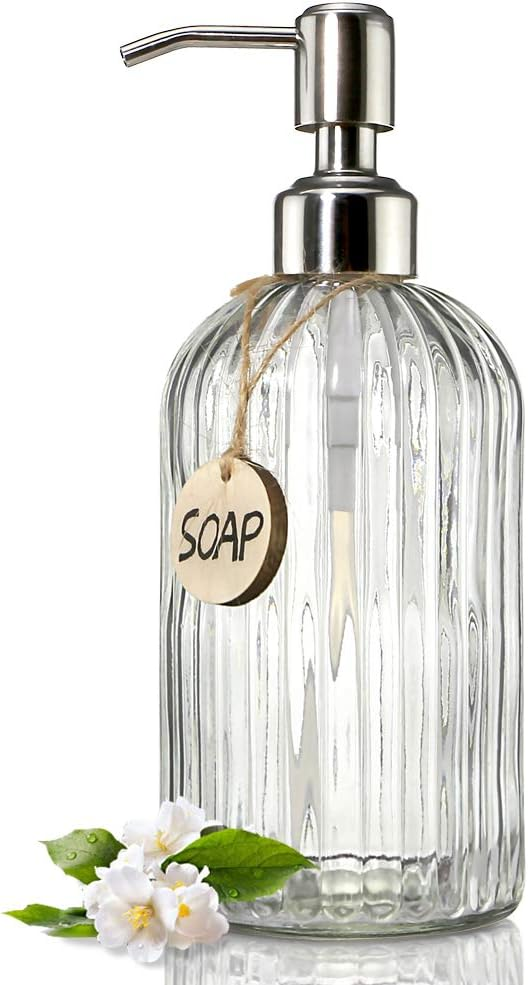
Selected version: One 18 oz clear ribbed glass bottle, silver-colored pump, and blank wooden tag. View the JASAI listing on Amazon.
What the bottle and pump offer
The clear, ribbed glass adds texture while keeping the soap level visible. Use the blank tag to identify the contents when similar bottles sit together or the liquid’s color gives little clue.
The projecting spout lets you catch liquid in a hand or on a sponge, with no batteries or charging. Unlike a sponge-press tray, it accommodates both movements. The seller specifies a 304 stainless steel pump and lists hand soap, dish soap, body cleanser, and lotion as intended contents. This is a liquid pump; a foaming refill will not make it dispense foam.
Fit, cleaning, and when to choose another bottle
- Care: Plan on hand washing, as the detailed listing recommends. Its separate dishwasher-safe claim does not identify the covered components, so whole-pump machine washing remains unconfirmed.
- Fit: Listed dimensions conflict: 3.2 inches in diameter × 7.7 high in the description, versus 3.52 × 3.52 × 7 inches in the specification table. For a tight shelf, confirm the assembled dimensions and allow access for refilling.
Choose the GMISUN pair if you need two matching bottles with ready-made labels. If bottles are often knocked against a hard basin, consider another material; ribbed glass still carries a breakage risk.
GMISUN: A Matching Pair for Hand and Dish Soap
Choose GMISUN if you want two liquids in matching bottles, with labels that make their jobs clear.
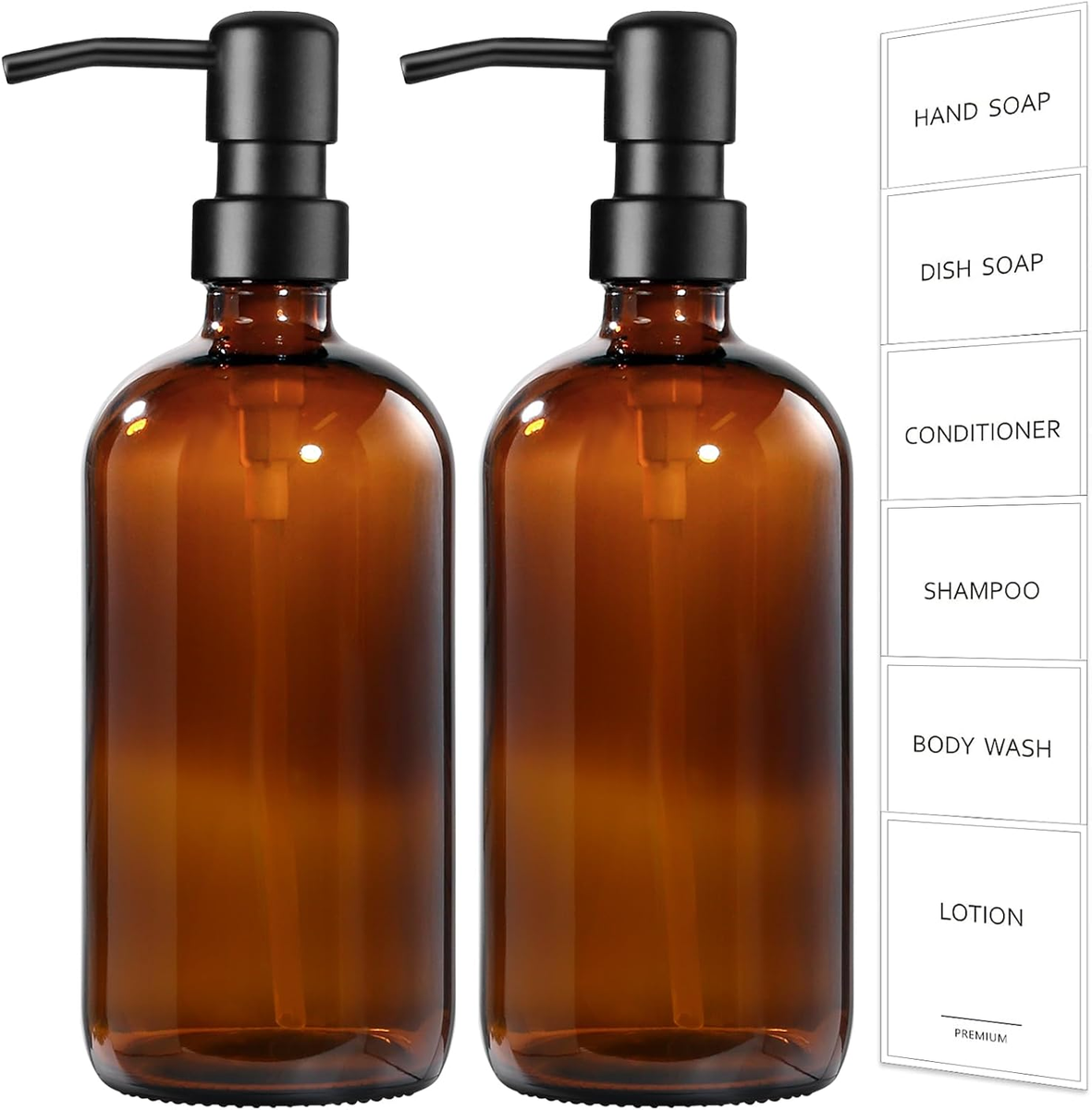
Selected version: Two amber glass bottles, 17 fl oz each, with black pumps and adhesive labels. Listed dimensions are 3 × 3 × 8.5 inches per bottle. View the GMISUN set on Amazon.
Two useful bottles, with a choice of labels
The matching amber bottles come with six label choices: Hand Soap, Dish Soap, Lotion, Body Wash, Shampoo, and Conditioner. Select two to distinguish kitchen or bathroom liquids without making your own labels. The seller calls the labels waterproof; repeated soaking and dishwasher resistance remain unverified.
Pump, placement, and continued use
The seller describes the black pumps as stainless steel and lists hand soap, dish soap, lotion, and body wash as intended contents. Press the top to receive liquid beneath the spout; each bottle keeps its own contents and refill schedule.
- Together at one sink: Allow two 3-inch bases plus room to reach both pump tops and spouts without moving a bottle aside.
- At separate sinks: The pair can coordinate two rooms. Check the listed 8.5-inch height and refill clearance at each location.
- Long-term reuse: A model-matched replacement pump and detailed component-cleaning instructions remain unconfirmed. Do not assume another black pump will fit or the whole assembly is dishwasher-safe.
For one liquid, consider one JASAI. For two liquids with visible fill levels, consider two clear JASAI bottles instead. Compare delivered totals for the number you need; a two-pack alone does not establish a saving.
S&T: A Top-Press Dispenser for Sponge Washing
Choose S&T if you repeatedly load a sponge with dish soap and want the soap and sponge in one place.
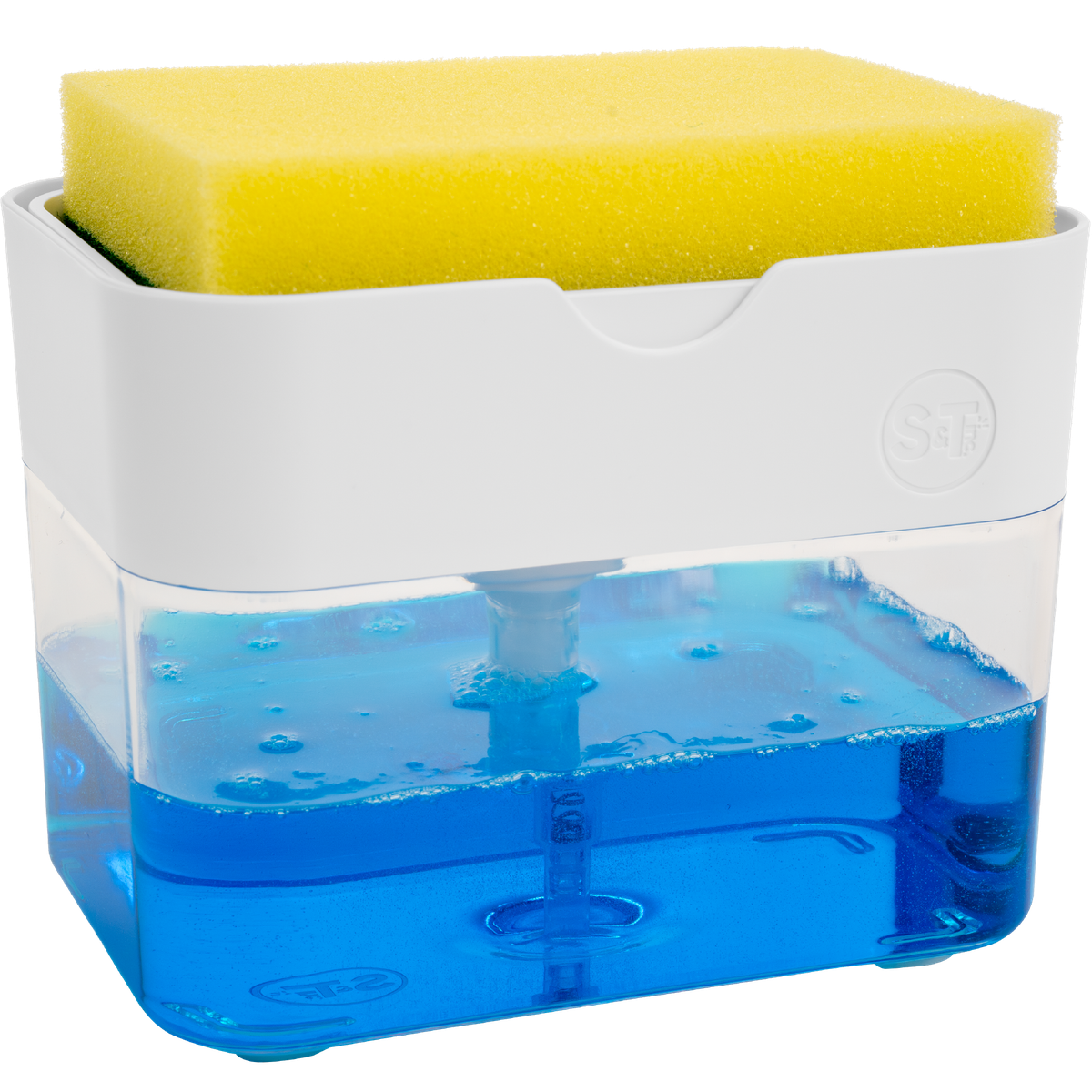
Selected version: White 13 oz plastic dispenser with a sponge included. S&T’s direct listing showed $9.99. Buy from S&T or view the selected white dispenser on Walmart.
How the sponge press changes washing up
Place the sponge on the raised plate, press to load it with liquid dish soap, then lift it to wash. Return it to the plate between uses. You can collect soap with the tool already in your hand, without tipping a separate bottle over it. S&T also lists cloths and scrubbers as suitable; this is not a foaming-hand-soap system.
What to allow for beside the sink
- Visible reservoir: Check the remaining soap before starting to wash.
- Non-slip feet: Intended to steady the base during downward pressing; grip depends on the counter and your pressing motion.
- Working space: The brand lists 5 inches wide × 3.5 deep × 3.9 high. Leave room above for pressing and lifting the sponge, and access for refilling.
Wet sponge residue can collect on the plate, adding a surface to your cleaning routine. Detailed disassembly and dishwasher instructions were not available, so these cleaning methods remain unconfirmed.
If you usually dispense into your palm or directly into a pan, a conventional spout better suits that motion.
Secura: A Larger Reservoir with Replaceable Batteries
Choose Secura if you want a touch-free pump with a dose set in advance and a larger, visible fill.
Selected version: Chrome V-470 with a 500 mL reservoir, about 16.9 US fl oz. It requires four AA alkaline batteries, sold separately. View the Secura listing on Amazon.
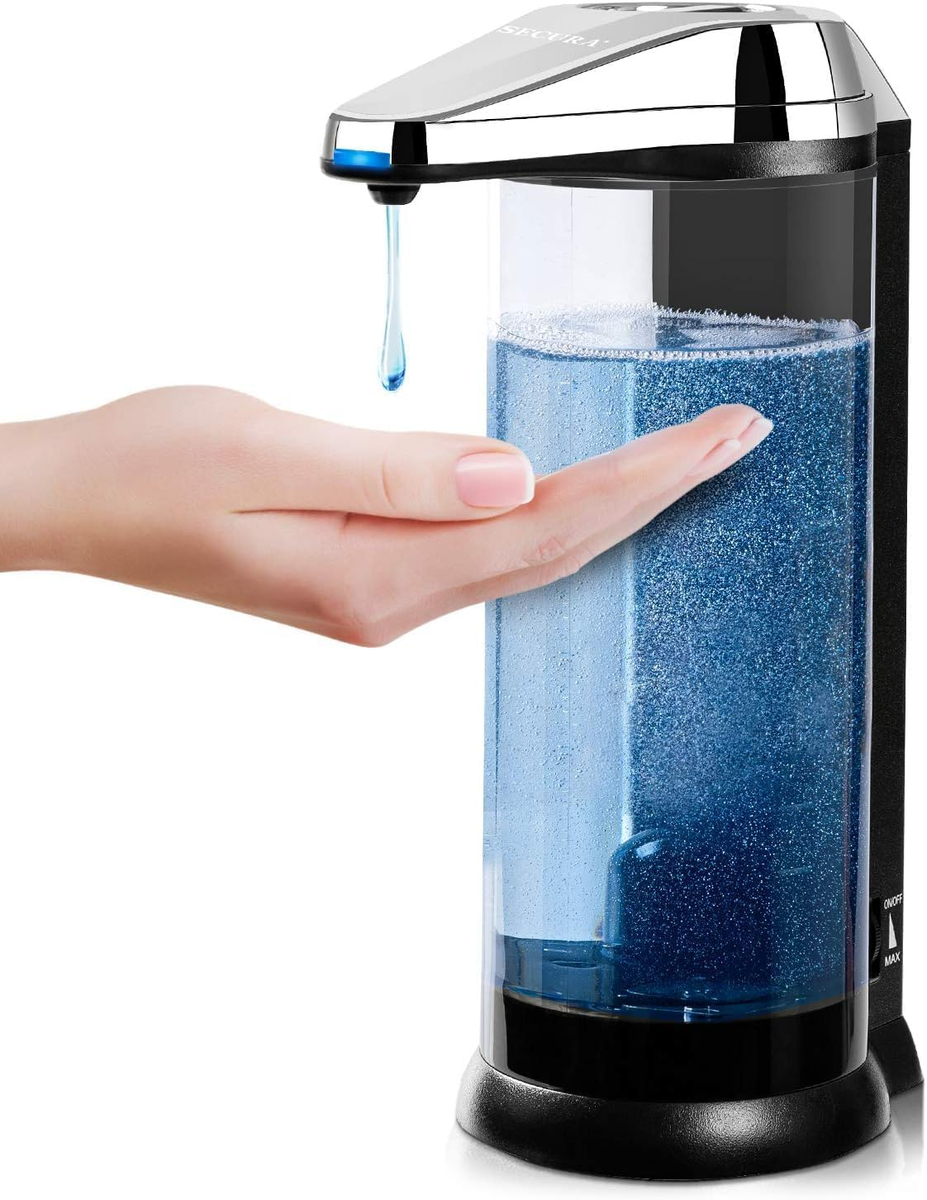
Set the amount, then use the same setting
The combined on/off and volume dial suits a household that usually wants one dose. Start near the middle and adjust if needed. You change the setting before use, rather than vary it with each hand movement as on simplehuman.
The transparent tank shows the remaining liquid. At similar consumption, its larger usable fill can extend the interval between top-ups at a busy sink.
Soap and batteries: The seller advises against thick or lotion-based soap, which can clog the pump or stop delivery, and against rechargeable AAs. Spare alkaline AAs let you restore power immediately.
Filling and maintenance you will repeat
The Secura operating manual, labeled ASD-500, describes this design’s routine:
- Fill and start: Open the lid, add compatible liquid soap, and turn the dial on. Initial use may need several sensor activations to draw soap through the tube.
- Clean: Wipe the exterior with a damp towel and the battery compartment with a dry one. For congealed soap, the manual directs you to empty the unit, dispense warm soapy water through it, then empty and refill.
- Store: Before a long break, empty and clean the unit, remove the batteries, and store it dry.
Use a level indoor surface away from direct sunlight and positions where water could cover the unit or repeatedly wet its switch. For changing doses at each use, see the simplehuman comparison.
simplehuman: Adjust Each Dose with Hand Position
Choose simplehuman if you regularly want to change the amount of soap as you reach for it.
Selected version: ST1082 in brushed stainless steel, 9 US fl oz, with an included charging puck and a listed two-year warranty. View the simplehuman pump on Target.
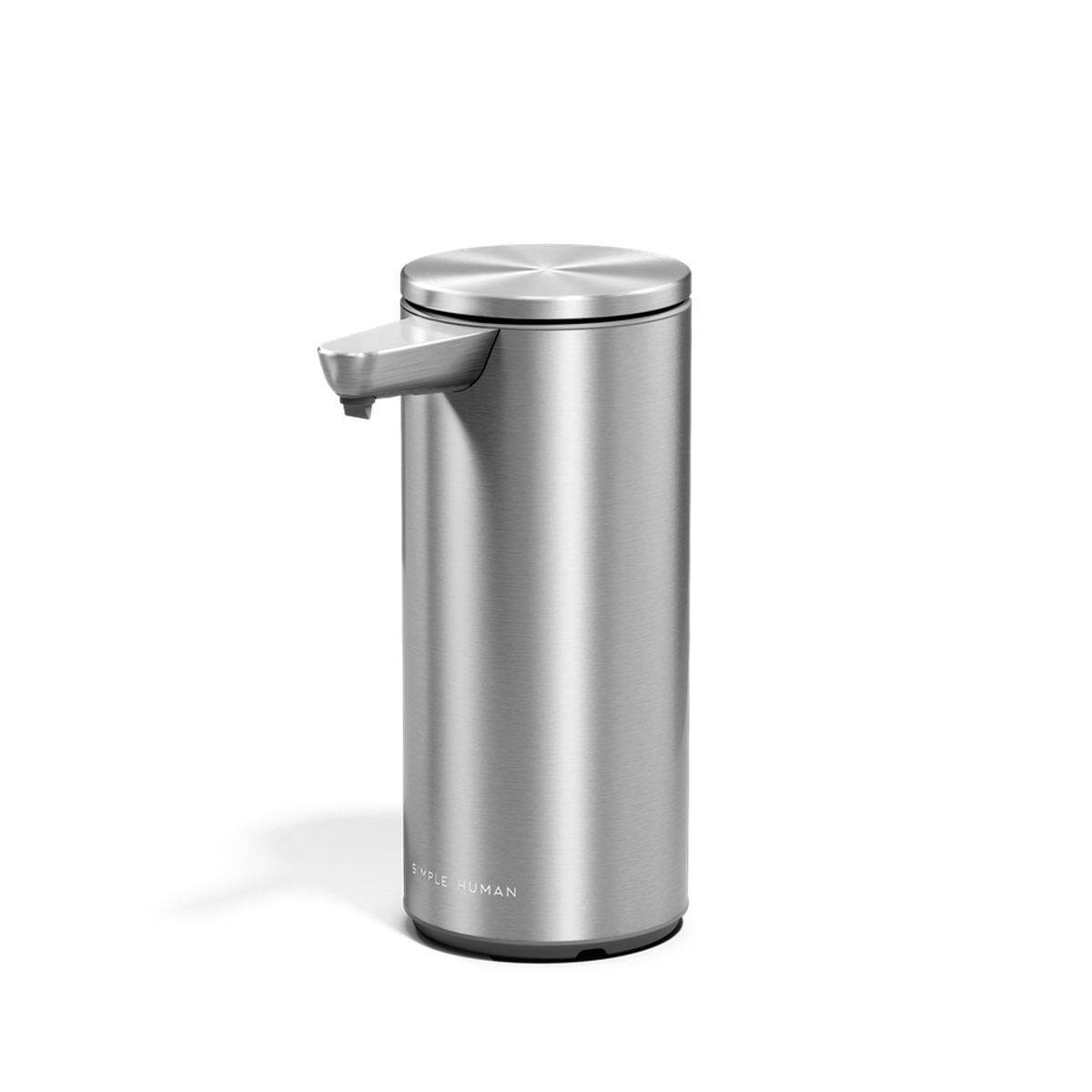
Choose the dose as you catch the soap
Hold your hand close to the sensor for less soap and farther away for more. Different users or tasks can get different amounts without resetting a dial: catching the soap also selects the dose.
The wide top opening gives room to pour from a refill container. At about 266 mL, its tank is smaller than Secura’s 500 mL; similar consumption means more frequent top-ups.
Soap compatibility: On the selected Target listing, simplehuman says this liquid model is unsuitable for lotion or soaps containing exfoliants or moisturizing beads. It is separate from the brand’s foaming pump.
Charging and cleaning
The included USB cable and 360-degree charging puck connect at the back. Allow access and a nearby power source. The brand recommends switching the pump off while charging, creating a brief interruption in use.
The support page for the newer 9 oz liquid pump explains the following:
- Power: Pulsing white means charging; solid white means full; solid orange means low charge. Stated charging time is about 3–4 hours.
- Outlet: Gently wipe dried soap from the spout with a wet paper towel if delivery is uneven.
- Sensor: For sensor problems, use the recommended microfiber cloth and rubbing alcohol on the sensor window only, not inside the soap reservoir.
Target lists wipe-clean care; soaking the charger or dishwasher washing is not established by water-resistance claims. The selected item’s price required adding it to the cart when checked.
Which of the two sensor pumps fits your routine?
| What changes your choice | Secura V-470 | simplehuman ST1082 |
|---|---|---|
| How you choose the dose | Set it with a dial in advance | Vary it with hand position at each use |
| Listed capacity | 500 mL / about 16.9 US fl oz | 9 US fl oz / about 266 mL |
| What you do when it runs out of power | Replace four AA alkaline batteries, which you supply | Recharge with the included puck |
After checking soap compatibility, choose Secura when one setting and a larger fill are useful. Choose simplehuman when changing the amount on the spot matters enough to accept a smaller tank and a charging routine.
Blueland: A Starter Set for Tablet-Based Foaming Soap
Choose the Slate set if you want to make foaming hand soap from tablets and need a compatible bottle.
Selected version: One 9 fl oz Slate glass foaming bottle with a black pump and one Lavender Eucalyptus tablet. View the Blueland starter set on Target.
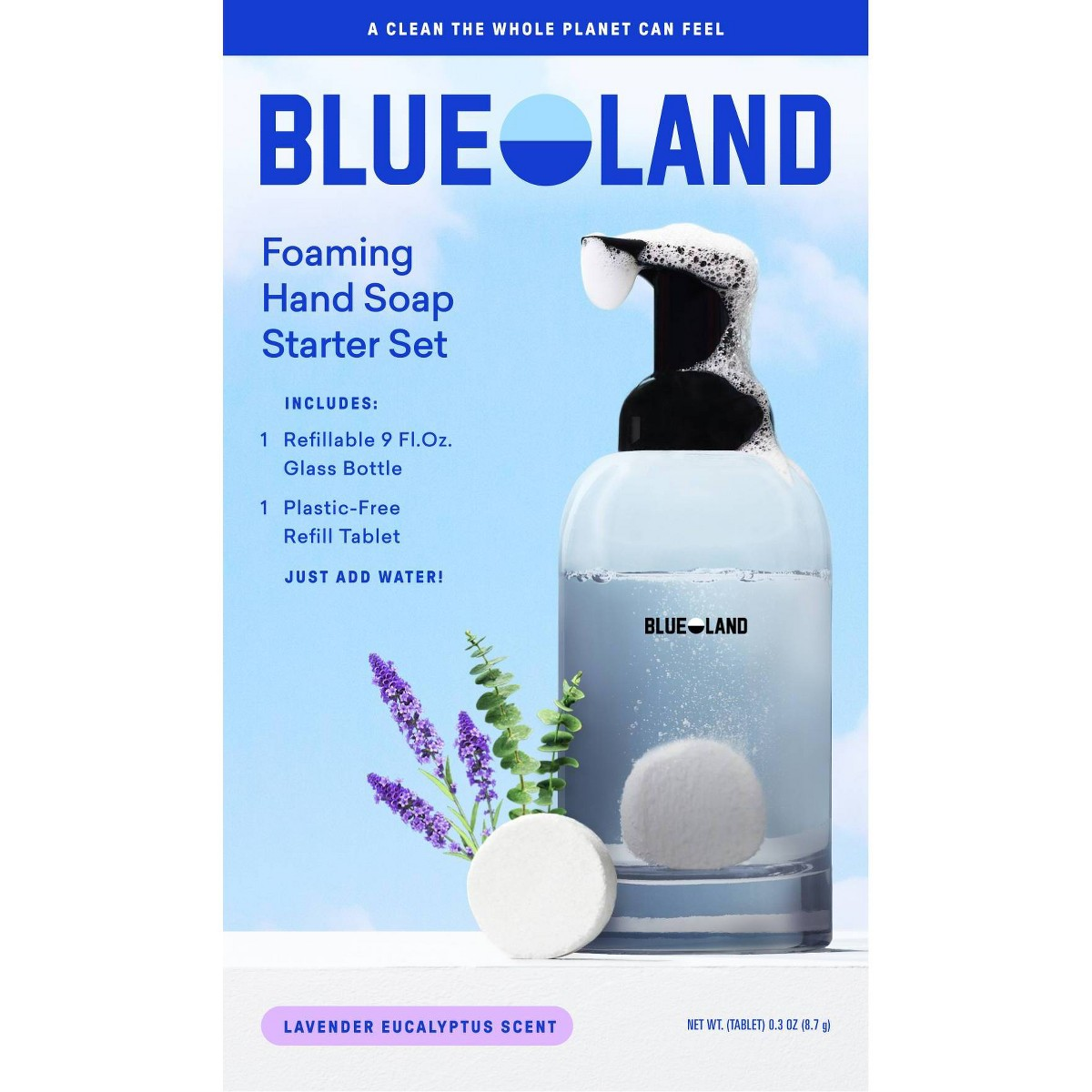
What you get at the sink
The fill mark guides the water quantity, and the pump turns the prepared solution into foam. This matched setup gets you started and leaves a bottle to reuse with later tablets.
Blueland describes the included Lavender Eucalyptus tablet through lavender, vanilla, and eucalyptus notes. The Classic Variety refill pack adds Perrine Lemon and Iris Agave, letting you try three scent directions with one bottle. These are brand descriptions, not our fragrance-test results.
Preparing each refill
Follow Blueland’s setup instructions:
- Leave the pump off and add warm water to the fill line.
- Add one tablet and let it dissolve; no shaking or stirring is needed.
- Attach the pump after dissolution.
The brand says this takes a few minutes; wait until the tablet dissolves. That preparation is part of every refill.
Starter cost, refills, and replacement parts
| What you buy | Listed price at Target | What it supplies |
|---|---|---|
| Slate starter set | $12.99 | One bottle and one tablet for the first 9 fl oz fill |
| Classic Variety refill pack | $6.99 | Three tablets for 27 fl oz of prepared soap |
| One prepared fill from that pack | $2.33 | One 9 fl oz fill at $6.99 ÷ 3, before water, tax, and delivery |
Compare costs by equal volumes of prepared soap. With a suitable foaming bottle that holds the 9 oz preparation, you can buy tablets alone. For immediate use after refilling, choose compatible ready-to-use foaming soap.
Blueland’s white replacement pump was listed at $3 before delivery. It changes the original black-pump appearance and may not fit bottles bought before May 2023. The brand also describes free pump replacements within 100 days of purchase for customers in the continental U.S.; check eligibility before buying a replacement.
Compare Capacity, Refills, and Upkeep
Use this table to compare the work each dispenser adds to your routine. Capacities are listed per bottle. Actual usable fills can differ, and prepared foam and liquid soap can be dispensed at different rates.
| Selected product | Listed capacity per bottle | Refill and upkeep |
|---|---|---|
| JASAI clear single | 18 US fl oz / about 532 mL | Refill with compatible liquid; plan on hand washing. Component-specific dishwasher permission is unclear. |
| GMISUN amber pair | 17 US fl oz / about 503 mL each | Refill each liquid as needed and maintain two pumps. |
| S&T top-press | 13 US fl oz / about 384 mL | Refill with dish soap and include the sponge plate in routine cleaning; detailed disassembly guidance was not found. |
| Secura V-470 | 500 mL / about 16.9 US fl oz | Use compatible liquid, replace alkaline AAs, and keep the battery compartment dry. Empty, clean, and remove batteries before long storage. |
| simplehuman ST1082 | 9 US fl oz / about 266 mL | Refill with compatible liquid, recharge with the puck, and wipe the sensor and outlet as directed. Not for lotion or particle-containing soap. |
| Blueland Slate | 9 US fl oz / about 266 mL of prepared solution | Add warm water and a tablet, then wait for it to dissolve. |
How to Choose a Soap Dispenser
Check whether the pump can dispense the soap you intend to use. Then think through the action you want to make easier.
Once those two things line up, decide how many bottles you need. Use the checks below to work out their capacity, operating space, and upkeep.
Do You Need a Liquid or Foaming Dispenser?
| Pump type | What happens inside | What the refill must provide |
|---|---|---|
| Liquid | The pump delivers soap as liquid | A liquid compatible with that pump |
| Foaming | The pump combines a suitable soap solution with air | A foaming refill or a solution prepared according to its instructions |
Manual and automatic describe activation; liquid and foaming describe the dispensing mechanism. A sensor does not make an ordinary liquid pump suitable for foaming refills.
Before choosing a bottle, check three things:
- Your existing soap: If you want to keep using a thick liquid or one containing particles, confirm that the selected pump accepts it.
- Preparation: Ready-to-use foaming soap, concentrates, and tablets involve different refill steps. A tablet system adds mixing and dissolution time.
- Dilution: Add water only when the soap and dispenser instructions permit it. There is no universal dilution ratio for every soap and foaming pump.
If you like your current refill routine, choose a compatible dispenser. If you want to change routines, include the preparation and future refill purchases in the decision.
Do You Need One Bottle or a Set?
Before comparing sets, give every bottle a clear job.
- Actual use: Identify the liquid and location for each bottle. An extra bottle is useful only if you have a reason to use it.
- Compatibility and labels: Check that each pump suits its assigned liquid. Matching bottles may need different pump mechanisms; bottles used together also need clear labels so people can identify the contents.
- Total purchase cost: If you need both bottles, compare the set's delivered total with the cost of buying two suitable bottles separately. If you need only one, compare the full set price with the delivered price of one suitable dispenser. A lower advertised price per bottle does not necessarily mean a lower outlay.
How Do You Want to Receive the Soap?
Think through the movement you make at the sink.
| Design | How you receive soap | When that action is useful |
|---|---|---|
| Manual pump with a spout | Hold a hand or sponge beneath the outlet and press | You want flexibility in what receives the soap |
| Top-press sponge dispenser | Press the sponge against the dispensing plate | You repeatedly load a sponge while washing dishes |
| Sensor dispenser | Place your hand within the detection area | You want to avoid pressing a pump |
Use your normal routine to check the details before choosing:
| What to check | How to make the judgment |
|---|---|
| What receives the soap | Identify whether you normally use your hand, a sponge, a brush, or a cloth. Check that the outlet or dispensing surface accommodates that item. |
| Manual operation | If you can try the dispenser, use your normal hand position and see whether you need to steady it with your other hand. Check again as the reservoir empties. A broad top alone does not establish low pressing force. |
| Output control | Check whether you can reduce the amount if a dose is too large, and how the adjustment works: a dial, a setting, or your hand position. Use the operating instructions to verify the control. |
| Power and maintenance | For replaceable batteries, check the specified type, replacement cost, and compartment access. For charging, identify where you would charge it, the required cable or adapter, and how a charging interruption would fit your routine. Follow the model's moisture precautions. |
How Much Soap Should It Hold?
Choose capacity around the interval between refills that works for you.
- Estimate use at that sink. Track how much ready-to-use soap is consumed over a week.
- Choose a refill interval. Multiply weekly use by the number of weeks you would prefer between fills.
- Check usable capacity. Compare the result with the permitted fill level, rather than the bottle’s brim-full volume.
Example: 100 mL used per week × a two-week refill interval = about 200 mL of usable capacity.
For two liquids, estimate consumption separately. Their combined capacity does not tell you how often either bottle will need refilling.
For a foaming system, use the amount of prepared solution in this calculation, not the weight or volume of its concentrate.
A larger reservoir can extend the interval between fills at the same rate of use. It also adds liquid weight when lifted. A lightly used guest sink may gain little from the capacity needed at a busy kitchen sink.
Capacity and footprint are separate checks.
Two dispensers holding the same amount can have very different shapes.
Which Material Makes Sense Beside Your Sink?
Consider three separate questions.
- Can you see the remaining soap? Clear glass or plastic makes the level visible. An opaque container needs another way to check it, such as a viewing window or opening the bottle.
- How will the bottle be handled? Glass and ceramic can break against a hard basin. If the bottle is likely to be moved or knocked over, weigh that risk against the appearance you want.
- What is the pump made from? The bottle, external pump finish, internal mechanism, and seals may use different materials. A metal-colored finish does not identify every internal part.
Use material information together with care instructions. Glass construction alone does not establish pump durability, and a stainless-steel exterior does not establish that every component is metal or immune to corrosion.
Will It Fit the Way You Use Your Sink?
Check the space in three stages.
- Mark the full footprint. Measure the base width and depth, then place a paper outline where the dispenser would stand. For a pair, lay out both bottles. Include any tray or sponge holder.
- Allow room for the operating movement. Check the spout’s projection, space beneath it for your hand or sponge, and clearance from the faucet handle. For a top-press design, leave room above the plate to press and lift the sponge.
- Allow room for refilling and cleaning. Check the height needed to lift out the pump assembly. Make sure you can remove a tray, open a battery compartment, or move the dispenser for charging without awkwardly rearranging the sink.
Check the outlet position: You should be able to receive soap without reaching around the faucet. Also consider where a residual drop would land.
Check sensor placement: Keep the detection area clear and follow the model’s placement guidance. Nearby objects can affect some sensors, so an empty-looking gap is not necessarily a suitable operating position.
What Makes It Easy to Refill, Clean, and Keep?
Refilling access
Look at the opening as well as the reservoir size.
- Can you aim your usual refill container into it?
- Can you see the fill limit?
- If you use a bottle brush, can it reach the shoulders and base?
A large bottle behind a narrow neck can still be awkward to refill or clean. For tablet systems, also check where you will prepare the solution and leave it while the tablet dissolves.
Cleaning the parts you will actually use
Treat the bottle, liquid path, and additional components as separate cleaning jobs.
- A dishwasher-safe claim applies only to the parts named.
- The pump may have different restrictions on soaking or washing.
- A sponge tray adds a surface to remove and clean.
- A sensor model may require attention to the detection area, outlet, and battery or charging components.
Look for instructions that explain how to clean inside the dispensing path as well as wipe the outside. Choose a routine you are willing to repeat.
Replacing a worn pump
Before buying a bottle you intend to keep, look for a compatible replacement pump. Check:
- The bottle connection and seal.
- Whether it dispenses liquid or foam.
- The intake-tube length.
- Any restrictions involving the bottle’s version or age.
A tube that is too short leaves soap beyond its reach. Matching the color or a nominal neck diameter alone does not prove compatibility.
Compare the replacement’s delivered cost with the cost of replacing the dispenser, and check whether the available finish matters to you.
Our bathroom soap-dispenser guide explores placement and materials in more detail. For glass bottles specifically, see our glass soap-dispenser guide.
Why Trust Us?
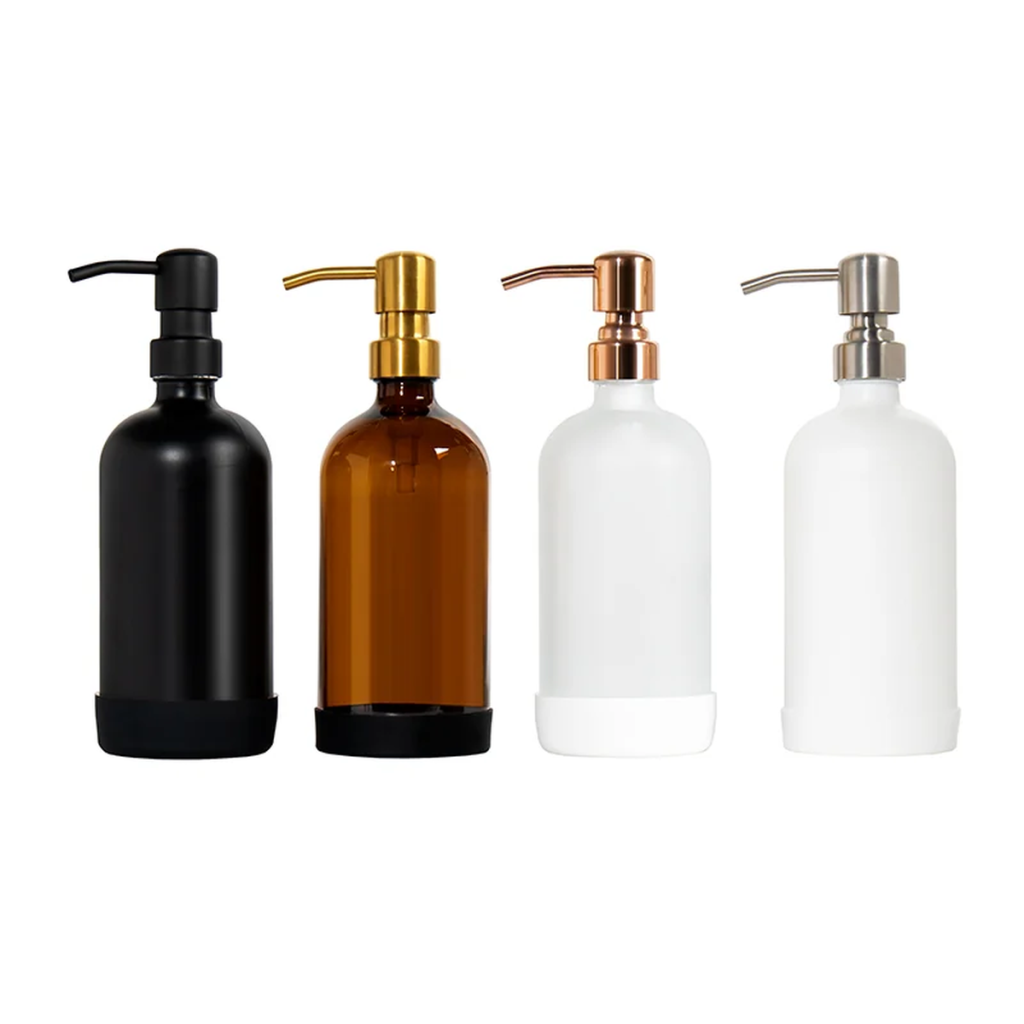
MimoPackage is a packaging business and the publisher of this guide. The product photos show the selected designs and packaging. Our editorial recommendations connect documented product features to specific sink routines.
Commercial disclosure. MimoPackage sells the wholesale configuration described below. We treat its bulk terms separately from the six household retail choices.
A Wholesale Option for Matching Glass Dispensers
For matching dispensers in quantity, Mimo’s Amber/Gold 500 mL configuration is a separate purchasing option. The configuration quoted for this guide has a base product price of $2 per unit, a 100-unit minimum order, and included latex base sleeves.
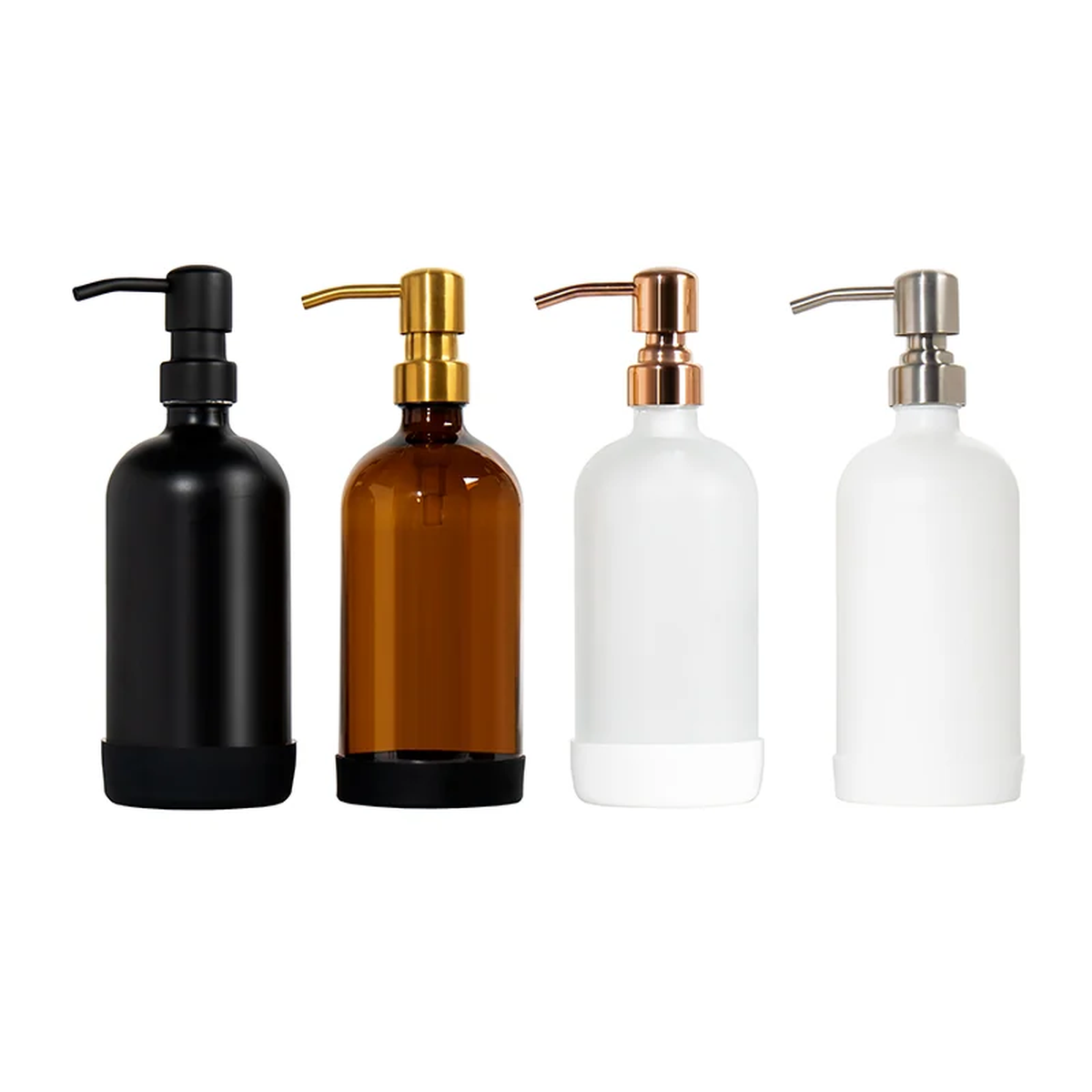
MimoPackage publishes this guide and sells this product. Its wholesale conditions differ from buying one or two household dispensers.
| Order detail | What it means |
|---|---|
| Amber bottle with gold-colored pump | One defined appearance across the order |
| 500 mL configuration | A consistent specified bottle capacity |
| Included latex base sleeve | Added friction at the base and cushioning when setting the glass down; it does not make the bottle drop-proof |
| 100-unit minimum | A base product subtotal of $200 |
A defined configuration gives buyers a starting point for coordinating multiple locations and discussing labels or printing.
The $200 subtotal is not a delivered or decorated order total. Samples, decoration, tax, freight, delivery timing, and final specifications need to be established for the order.
For a household that needs only one or two bottles, the retail options above are more relevant than a minimum order of 100.
View the Mimo Amber/Gold configuration and request a sample or quote.