How to Choose a Bathroom Soap Dispenser
Choose a bathroom soap dispenser by matching the pump to your soap and the bottle to the space where you will use it. Check those two conditions before comparing comfortable operation, refill frequency, cleaning access, and appearance.
Use this order to narrow the choice:
- Start with your refill. Keep a liquid pump if you want to continue using a compatible liquid hand soap; choose a foaming system when you want foam and will use the refill it requires.
- Choose a supported position. Check the counter, wall, or built-in installation conditions, including room for your hand and for removing the pump.
- Balance everyday effort. Compare pressing or charging, the weight you will lift, how often you want to refill, and how you will clean the bottle and pump.
- Choose the finish and purchase quantity. Among the options that meet those needs, select the appearance and accessories you will use. The product examples at the end distinguish single purchases from a wholesale project order.
Liquid versus foam describes the output; manual versus automatic describes how it is triggered; countertop versus wall-mounted or built-in describes placement. These choices can combine. For example, a manual foaming bottle can stand on a counter or sit in a compatible wall holder.
1. Match the Pump to Your Soap and Hands
First choose liquid or foaming output, then manual or automatic operation. After that, check the pump’s return mechanism and sealing. These details determine whether the dispenser works with your refill and fits the way you use the sink.
Dispensing Mode: Match Your Soap and the Way You Use It
Start with the result you want in your hand:
- Liquid pump: Choose a liquid pump compatible with your usual hand soap if you want to keep using it. It dispenses the soap as liquid, without requiring a foaming refill. Very thick or particle-containing soaps need a pump specifically suited to them.
- Foaming pump: Choose this if you prefer ready-made lather that spreads readily over wet hands. Use a foaming refill or the preparation method specified for that system; thick liquid soap is not a direct substitute. Foam gains volume from air and can be delivered with a smaller liquid dose, but actual consumption depends on the dose and how many times you press.
Then choose how to trigger that output:
| Operating method | Why choose it | What to consider |
|---|---|---|
| Manual pumps | Straightforward operation with no batteries or charging. | A broad, reachable head and a spout you can comfortably place your hand beneath make repeated use easier. |
| Automatic pumps | Receive soap without touching or pressing the head—a useful convenience at a shared sink or when pressing is uncomfortable. | Allow for charging or battery replacement and sensor cleaning. Dose adjustment is worth choosing if the default serving is too large or small for your needs. |
Water protection for automatic dispensers: For an automatic bathroom dispenser, match water protection to its position and cleaning routine. IPX4 covers splashing; IPX5 adds protection against water jets under test conditions. Neither means the unit can be immersed. Follow the model’s cleaning instructions even with an IP rating: some IPX5 dispensers still specify wiping rather than rinsing. A well-protected power compartment matters wherever splashes or refill spills could reach it.
If you want easier operation without charging: Start with a manual pump you can reach and press comfortably; a wide head alone does not prove low pressing force. If pressing itself remains uncomfortable, the touch-free action of an automatic model may matter more than avoiding battery or charging upkeep.
Spring Material: Stainless Steel or All-Plastic
Stainless-steel springs offer corrosion resistance for repeated use around moisture and soap. A design that keeps the spring outside the liquid path also avoids continuous contact with the refill. Favor this arrangement when you want a conventional spring pump with less metal-to-soap contact.
All-plastic return mechanisms remove the metal spring, eliminating spring rust as a cause of trouble. If rusty springs have been a recurring problem, this removes that failure source. Pressing effort and return speed still depend on the design and the soap: all-plastic pumps can use different spring designs for different viscosities.
These descriptions concern the internal mechanism. A silver or gold pump cover does not identify the spring beneath it. Once the pump is primed, a comfortable downward press, prompt return, and consistent repeated output are the useful signs to assess.
Sealing: Keep Soap in the Bottle and Off the Counter
Choose features that address the place where unwanted soap could escape:
- At the bottle neck: A matched pump collar and an intact gasket, such as a silicone ring, help seal the connection. A complete bottle-and-pump assembly reduces the fitting work involved in buying the parts separately.
- At the spout: An anti-drip outlet or an outlet valve designed to shut off between doses helps keep the basin cleaner. This is particularly useful if drips would land on a tray or countertop instead of inside the sink. Internal one-way valves manage flow through the pump; choose an explicitly anti-drip outlet for drip control.
- During moving or storage: A twist lock or locking ring prevents accidental pressing. Choose this feature if you regularly put the dispenser away or move it with other toiletries; sideways transport still needs an explicitly leak-resistant design.
2. Choose a Stable Dispenser and the Right Placement
Choose a countertop bottle for easy moving, a wall-mounted system to free counter space, or a built-in dispenser when the sink has suitable installation conditions. Compare how each will be supported, refilled, and removed for cleaning.
Choose Between Countertop, Wall-Mounted, and Built-In
- Countertop: Suits flexible positioning without altering the wall or counter. You can lift the bottle to wipe underneath it or take it to a more open area for refilling.
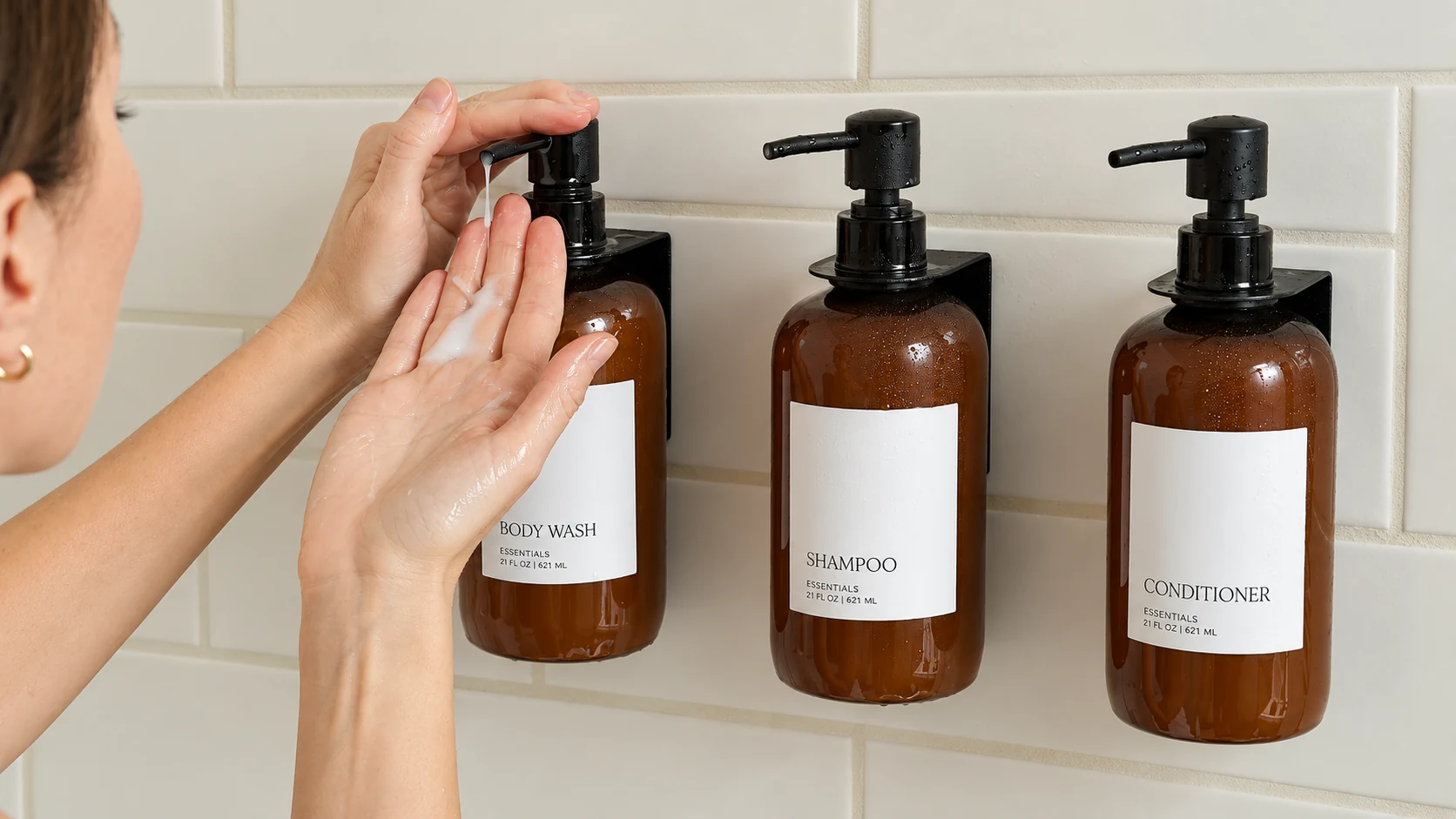
- Wall-mounted: Choose a compatible bottle and holder, checking the neck, body width, and support points rather than capacity alone.
- Mounting: Adhesive mounts need the specified surface; drilled mounts need suitable fixings and permission to alter the wall.
- Refilling: This may require only pump removal. Make sure you can reach and remove the pump.
- Removal for cleaning: Taking the bottle down may mean releasing a neck restraint or lower support. Make sure these are accessible too.
- Built-in: Requires a suitable mounting hole or planned installation, with the reservoir below the counter and dispensing head above. Top filling reduces routine reaching under the sink, but there must still be enough under-counter space to accommodate and remove the reservoir when necessary.
If you need counter space but cannot drill: A wall holder is useful only when its approved mounting method suits your wall. Check the specified surface and removal conditions before choosing an adhesive mount. If those conditions do not fit your bathroom, use a countertop bottle whose entire base fits the ledge rather than relying on an unsuitable wall fixing.
Look for Stability During Pumping
The whole base should rest securely on the surface, with room to press the head straight down.
A footprint that overhangs a narrow ledge lacks full support. A broader base and lower center of gravity generally resist tipping better; extra weight alone does not settle the choice. Avoid a position that forces you to reach around the faucet or press sideways.
A non-slip base addresses sliding, so it complements secure support. Mimo’s Amber / Gold dispenser includes a latex sleeve that adds grip against the counter and cushions contact when the bottle is set down.
3. Choose the Right Capacity, Size, and Refill Opening
Start with a smaller capacity for occasional use, or a larger one if frequent refilling is a nuisance. Then compare the complete dimensions and refill opening: extra capacity may add height rather than width, and the bottle you choose should be easy to fill from your usual refill container.
Choose Capacity Around Your Soap Use
Use these sizes as starting points for comparing how much soap you want to keep at the sink:
- Around 250 mL: A useful starting point for a lightly used sink or when you prefer to carry less liquid while moving the bottle. At a busy sink, the smaller supply means more frequent refills.
- Around 300 mL: A middle option if 250 mL needs replenishing too often but you do not want as much stored liquid as a 500 mL bottle. Compare the actual dimensions before assuming it takes substantially less space.
- Around 450–500 mL: Worth considering for frequent use, especially when several people share the sink and topping up has become a chore. The extra supply can extend the refill interval, but also adds to the weight you lift.
Choose around actual use: how often people wash their hands and how much the pump dispenses both affect consumption. Household size alone does not determine the right capacity. If you want to estimate how long a refill will last, use:
Approximate refill interval = usable liquid fill ÷ average daily liquid consumption.
Compare the Complete Size, Not Just the Capacity
Once you have a capacity in mind, compare bottle width and height with the pump fitted. These manufacturer-listed examples show how extra capacity and different shapes affect the fit. They come from one liquid-pump series and a separate foaming series, rather than the five product examples below.
| Configuration example | Capacity | Height including pump | Bottle diameter |
|---|---|---|---|
| Liquid series, small | 250 mL | 180 mm | 59 mm |
| Liquid series, medium | 300 mL | 190 mm | 68 mm |
| Liquid series, large | 500 mL | 220 mm | 69 mm |
| Separate foaming series | 500 mL | 190 mm | 81 mm |
The listed tolerance for the foaming example is ±1 mm. Bottle diameter does not include the full reach of the spout.
Fewer refills on a narrow counter: In the liquid series, moving from 300 to 500 mL adds 200 mL while increasing diameter by only 1 mm and height by 30 mm. The larger bottle may suit a narrow counter with open space above it, but the extra height could rule it out beneath a low shelf. If you cannot accommodate the height or a wider alternative, choose a bottle that fits and accept a shorter refill interval.
Same capacity, different shape: At the same 500 mL capacity, the foaming example is 30 mm shorter and 12 mm wider than the liquid example. A low, wide space may favor that shape; a narrow gap may favor the taller bottle. Keep the dispensing mode you selected in Step 1: the shape still needs to work with your soap.
Allow space to catch soap, press the head, and remove the pump—not just space for the bottle base.
Choose an Opening That Makes Refilling Easier
Opening width: A wide opening is easier to aim for with a heavy refill bottle or pouch; a narrow opening can work with a controlled pouring spout. Compare the clear opening itself: an external neck-thread measurement does not tell you how much pouring space is available.
Fill level: A visible liquid level or marked fill limit helps prevent overfilling. OXO’s wide opening and MAX line provide both a clear pouring target and stopping point.
Pump removal: A screw-on pump requires gripping and turning the collar; a pull-out head lifts out and presses back into place. Compare both opening width and removal method, and choose the action you find comfortable.
4. Choose a Material You Can Handle and Maintain
Compare materials by soap-level visibility, handling weight, breakage concerns, and care requirements. Choose among bottles that already suit your refill and available space. The bottle material and the pump’s internal materials are separate decisions; a metal-colored cover does not tell you what is inside.
When to Choose Glass
Choose clear or tinted glass when seeing the remaining soap matters. Clear glass shows the refill’s color directly; amber changes its appearance, and dark contents or labels can make the level harder to see. Glass is a useful choice when you can give the bottle a stable position and handle it comfortably during refilling.
If you like glass but move the bottle often: Consider the weight when filled and how securely you can grip it. A smaller fill reduces the liquid you lift but means more frequent refilling. A base sleeve can help with sliding or contact at the base; it does not make glass unbreakable. If dropping a brittle bottle is your main concern, compare a plastic alternative.
For more on choosing, using, and caring for glass dispensers, see our Glass Soap Dispensers Guide.
When to Choose Ceramic or Stoneware
Choose an opaque ceramic or stoneware body when you want the bottle’s appearance to stay consistent as the soap changes. The tradeoff is that you cannot check the liquid level through the body. These materials also need a secure position: switching from glass to stoneware does not remove breakage concerns. Follow the care instructions for the glazed or coated product rather than assuming it can be washed like bare glass.
When to Choose Plastic
Choose a lightweight plastic dispenser when easier lifting and reduced concern about a dropped glass or ceramic bottle matter more than a weighty decorative finish. Clear PET or PETG lets you see the soap; opaque HDPE or PP keeps the bottle’s color consistent. A light bottle still needs a stable base and a pump you can operate without pushing it sideways.
When shopping, look for an explicit BPA-free label in the manufacturer’s product information. The resin name alone does not establish that claim for a particular dispenser. Check the finished product’s cleaning instructions as well.
When to Choose a Metal-Finish Dispenser
Choose a metal-finish dispenser when coordinating with the faucet matters, then check whether it has a clear level window and what the complete product is made from. An opaque body hides the refill; a viewing window lets you monitor it while keeping most of the metallic exterior. The finish does not establish the pump’s internal construction or permit dishwasher cleaning.
5. Choose a Dispenser That Is Easy to Clean and Maintain
Choose a bottle you can reach inside, a pump with a cleaning method you are willing to repeat, and an identifiable replacement pump if you want to keep the bottle long term.
Choose a Bottle You Can Clean Inside
A short, wide bottle may be easier to work inside than a tall, narrow-necked one of the same capacity. Compare access at three points:
- Opening: It must admit your brush, but entry alone is not enough: you also need room to move it inside.
- Shoulders: Smooth shoulders help bristles reach the surface and water drain. Broad shoulders behind a narrow neck can require a differently shaped brush.
- Base: The handle must be long enough for the bristles to reach the bottom. Rounded inside corners help the brush reach surfaces and water drain; recessed bottom corners can require a differently shaped brush.
Choose a bottle designed for rinsing only if you are comfortable with that method.
Choose a Pump with a Practical Cleaning Method
Access: A pump that comes off easily gives access to the bottle neck, nozzle, and intake; a dip tube designed to detach can be rinsed separately. These features help you reach residue around the parts handled during refilling.
Cleaning method: Pump-through flushing clears the liquid path without opening the internal mechanism. Permitted disassembly gives more direct access, but adds pieces to rinse, keep track of, and reassemble. More removable parts are worthwhile when that access helps you; they are not a requirement for every cleanable pump.
Model-specific care: If you want dishwasher cleaning or soaking, choose a model that explicitly permits that method for the relevant parts. A washable bottle does not mean the complete pump or electronic dispenser can be immersed. EKOLN and STORAVAN specify damp-cloth cleaning with a mild cleaner and drying afterward. OXO 13273700 excludes bleach and dishwasher use.
Choose a Clear Replacement Route
If keeping the bottle long term matters, choose a dispenser with an identifiable matching replacement pump.
A pump intended for the same model reduces fitting work and lets you retain an undamaged bottle. An alternative must match the dispensing type, neck and sealing interface, and dip-tube length. Similar color or a shared neck-diameter number is not enough: the connection must seal, and the tube must reach the liquid without its intake being blocked against the bottom.
If no suitable replacement can be obtained, replacing the complete dispenser may be necessary. For Mimo’s wholesale styles, include a matching spare-pump option in your configuration request so it can be confirmed with the order.
6. Match the Dispenser to Your Bathroom Style
Once the dispenser suits your soap, space, handling, and care routine, choose its appearance. Start with the faucet, cabinet, or countertop. Repeat a color, finish, or shape through the bottle and pump, then add only the accessories you use. The pieces can coordinate without being identical.
Build Around Your Existing Fixtures and Finishes
| Existing bathroom feature | Dispenser combination | Why the combination works |
|---|---|---|
| Warm wood cabinets or beige stone | Amber bottle with a gold- or copper-colored pump | Brown glass echoes the warm background; the pump adds a reflective detail. |
| White basin and a pale countertop | Clear or white bottle with a white or silver-colored pump | Light tones keep the arrangement simple. Clear glass shows the soap color; opaque white stays consistent across refills. |
| Black faucet or mirror frame | A clear, amber, or pale bottle with a black pump | The pump repeats the dark detailing; clear glass looks light, amber adds warmth, and a pale opaque body adds contrast. |
| Vintage hardware or an ornamental bathroom | Ribbed or embossed glass with an antique-brass- or gold-colored pump | Texture and the metal-colored finish echo decorative details; a simpler silhouette gives a quieter accent. |

Choose the Pieces You Will Actually Use
Single bottle: One bottle is enough when hand soap is the only product you use at that sink.
Pair: Choose a pair when both hand soap and lotion belong there. Matching silhouettes, pump finishes, or labels coordinate them; clear HAND SOAP and HAND LOTION labels distinguish the contents. Each pump must suit its liquid, and different consumption rates may justify different capacities.

Accessories: Add a toothbrush cup or tray when needed. STORAVAN’s three-piece set suits a sink that needs all three pieces. A tray gathers items together but adds its own footprint and another surface to clean; leave room to use and lift each item comfortably.
7. Compare Product Examples for Your Purchase
These five examples show how the choices above translate into specific bottles and sets. Compare the quantity and included pieces you will actually use, not just the lowest unit price.
IKEA and OXO links lead to their product purchase pages. MimoPackage links lead to the selected configuration and an order inquiry. Prices can change; use the relevant purchase page or quote for the current order total.
For a Single Bottle or Small Bathroom Set
Choose OXO for the combination of a metal exterior, level window, and refill features; EKOLN for an opaque stoneware single bottle; STORAVAN if its lightweight three-piece set is useful; or Mimo Tall / White if you want a single glass foaming bottle. The Mimo single-bottle option described here is the Tall / White configuration.
OXO Good Grips Stainless Steel Soap Dispenser — 13273700
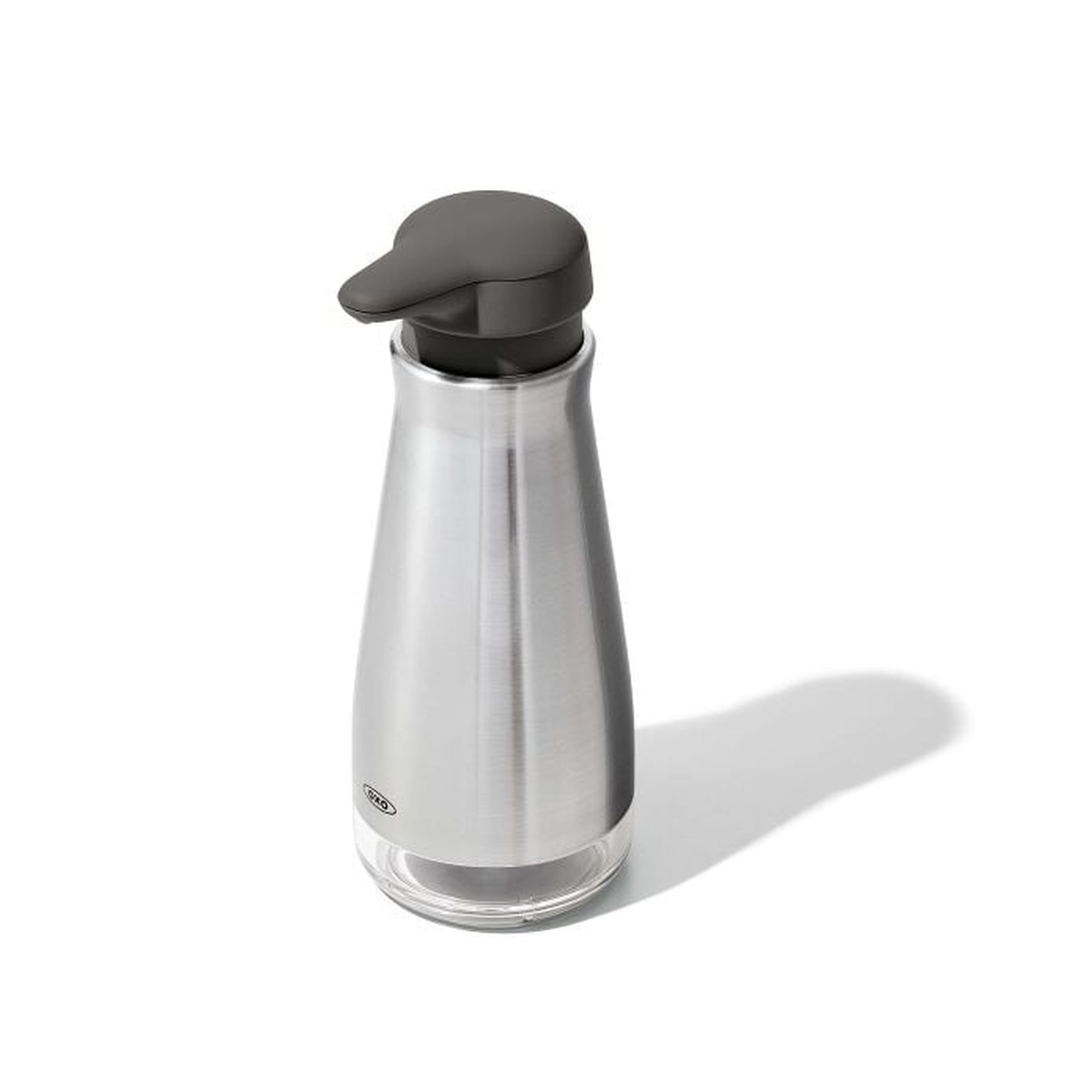
When to choose it: This OXO liquid dispenser suits a sink where you want to match silver-colored hardware, see how much soap remains, and refill through a wide opening. Its MAX line makes the stopping point clear.
- Construction and output: Stainless steel, plastic, and silicone; liquid soap dispensing.
- Listed capacity: 12 oz.
- Design details: Wide soft press surface, angled spout, non-slip base, clear level window, and wide refill opening.
- Price: US$25.99.
- Care: The same model’s official care information excludes bleach and dishwasher use.
Compared with the opaque IKEA examples, OXO combines a visible liquid level with a wide opening, MAX line, and non-slip base. Choose it if those features address your daily refilling and dispensing needs; the higher price alone does not establish a longer service life. The wide press surface gives the hand more contact area; it does not by itself establish how much force an individual needs. Choose a foaming system if you want ready-made foam rather than liquid output.
Where to buy: Buy or view the dispenser at OXO US.
IKEA EKOLN, Dark Gray — 404.416.19
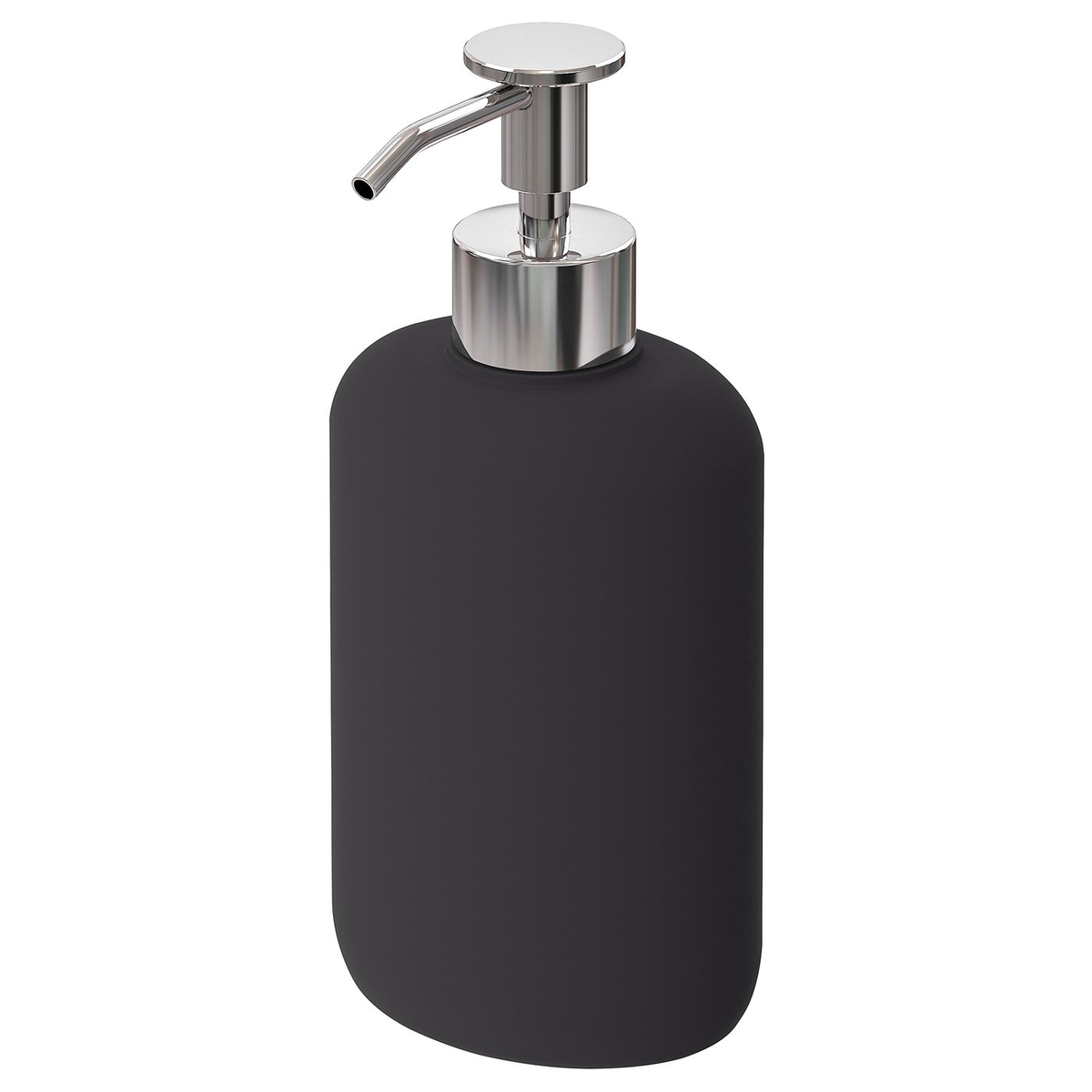
When to choose it: EKOLN offers a defined dark-gray accent with a silver-colored pump. Choose it for an opaque stoneware single bottle that keeps its color consistent across refills, particularly if you already use matching EKOLN accessories. Choose STORAVAN instead if a lightweight plastic set better suits your handling needs and you will use the extra pieces.
- Construction: Stoneware body with glaze and coating; mixed-material pump with stainless steel and plastic components.
- Listed capacity and height: 10 oz; 7 in high.
- Price: US$9.99 for one dispenser.
- Care: Wipe with a damp cloth and mild cleaner, then dry with a clean cloth.
Choose a clear or windowed dispenser if seeing the remaining soap is more important than an opaque color block. For a narrow ledge, obtain the bottle’s actual width and pump reach before deciding: the listed height does not describe its complete footprint.
Where to buy: Buy or check local availability at IKEA US.
IKEA STORAVAN, White Three-Piece Set — 704.290.03
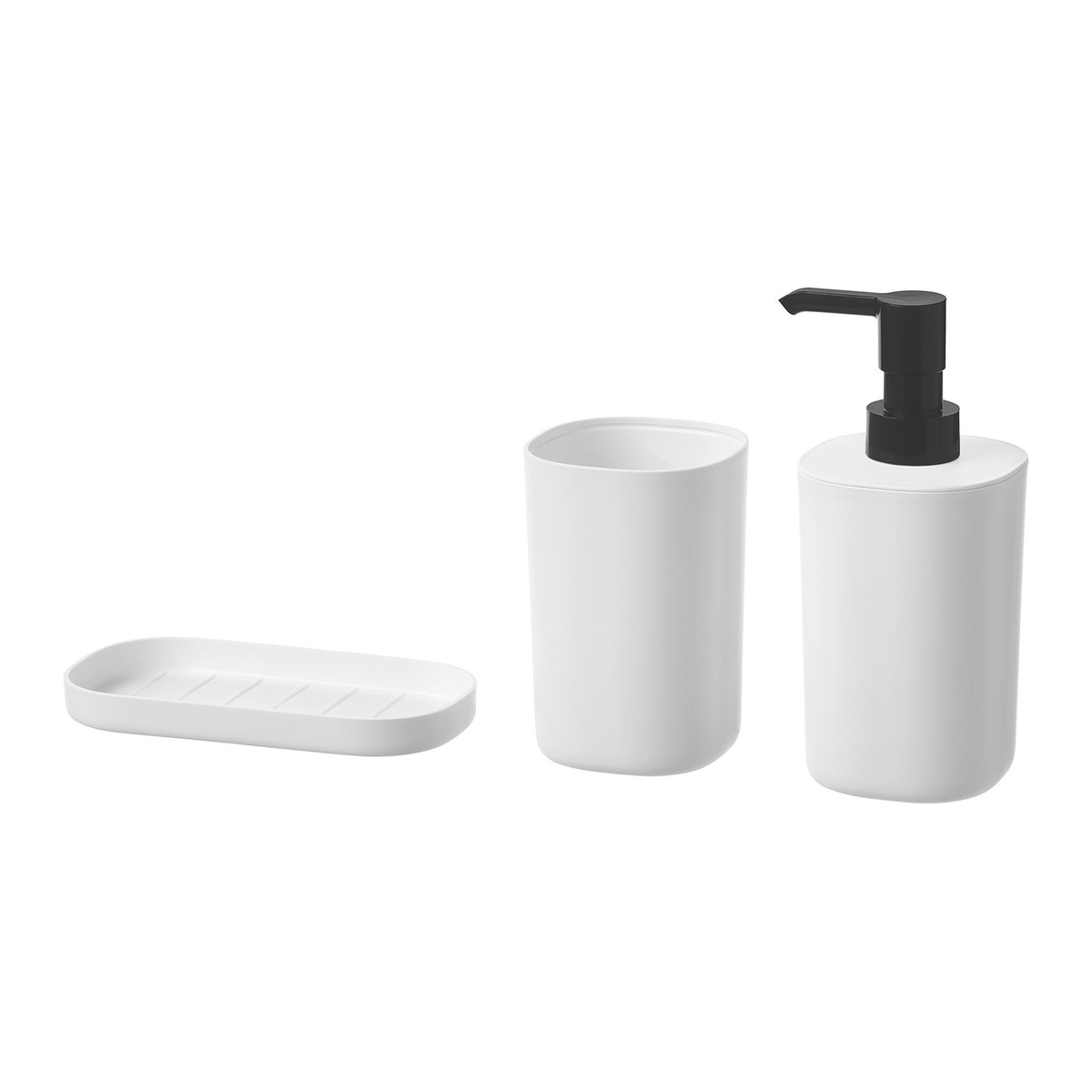
When to choose it: Choose STORAVAN when you want lightweight plastic accessories and all three pieces have a job at your sink. Its value is the included bottle, cup, and tray; it does not offer the same liquid-level view as a clear bottle or OXO’s window. The white containers keep the appearance consistent, and the black pump adds a small contrasting detail.
- Construction: PP containers and tray; PE/PP pump.
- Dispenser: Listed capacity 13½ oz; height 6½ in.
- Other pieces: Toothbrush cup 4⅜ in high; tray 5¾ × 3 in.
- Price: US$4.99 for the three-piece set.
- Care: Wipe with a damp cloth and mild cleaner, then dry.
If you only need a soap bottle, the cup and tray do not automatically add useful value. You can also use the pieces separately rather than crowding them onto one ledge. The tray dimensions describe the tray, not the total space required when all three pieces are spread out.
Where to buy: Buy the three-piece set or check availability at IKEA US.
Mimo Clear Glass Foaming Dispenser
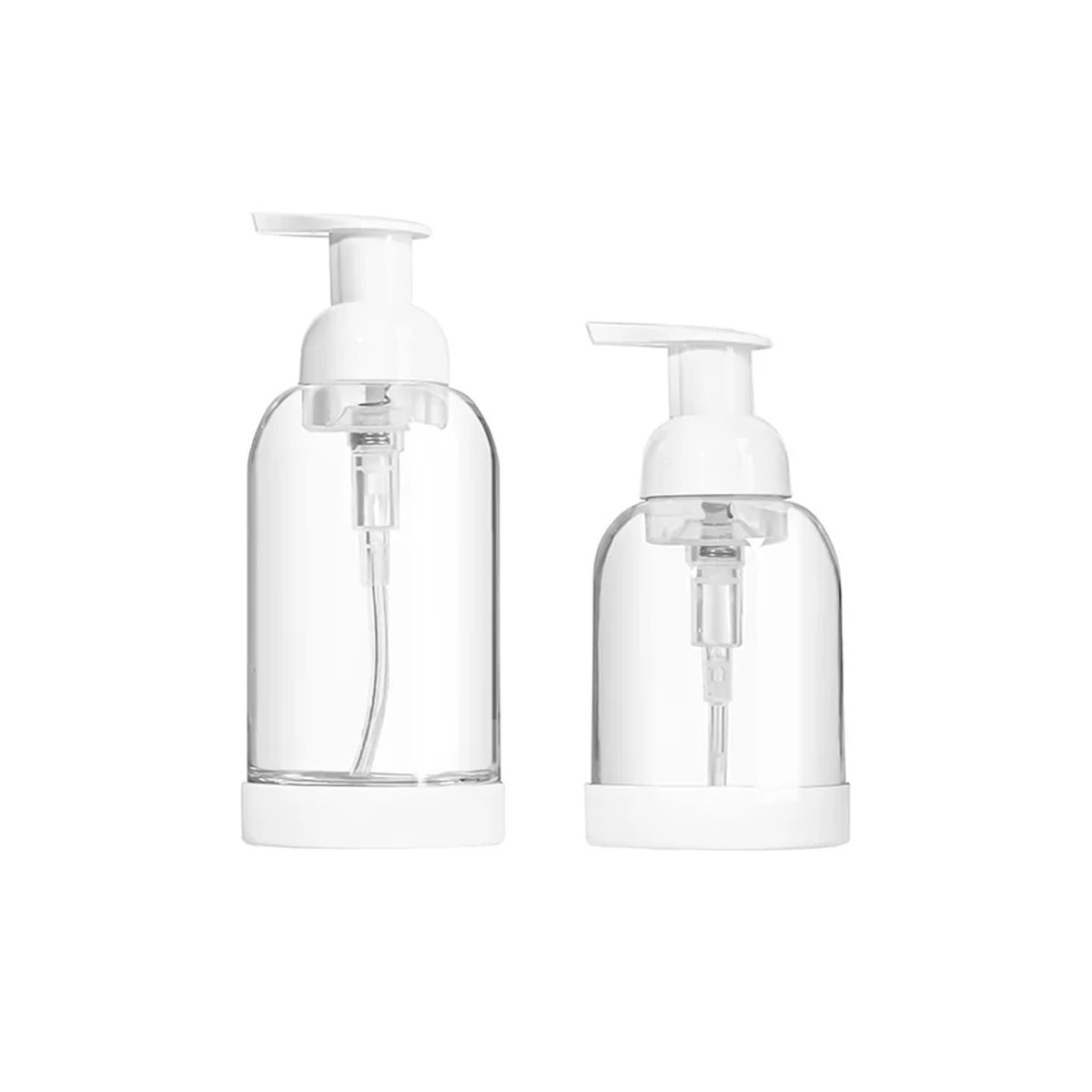
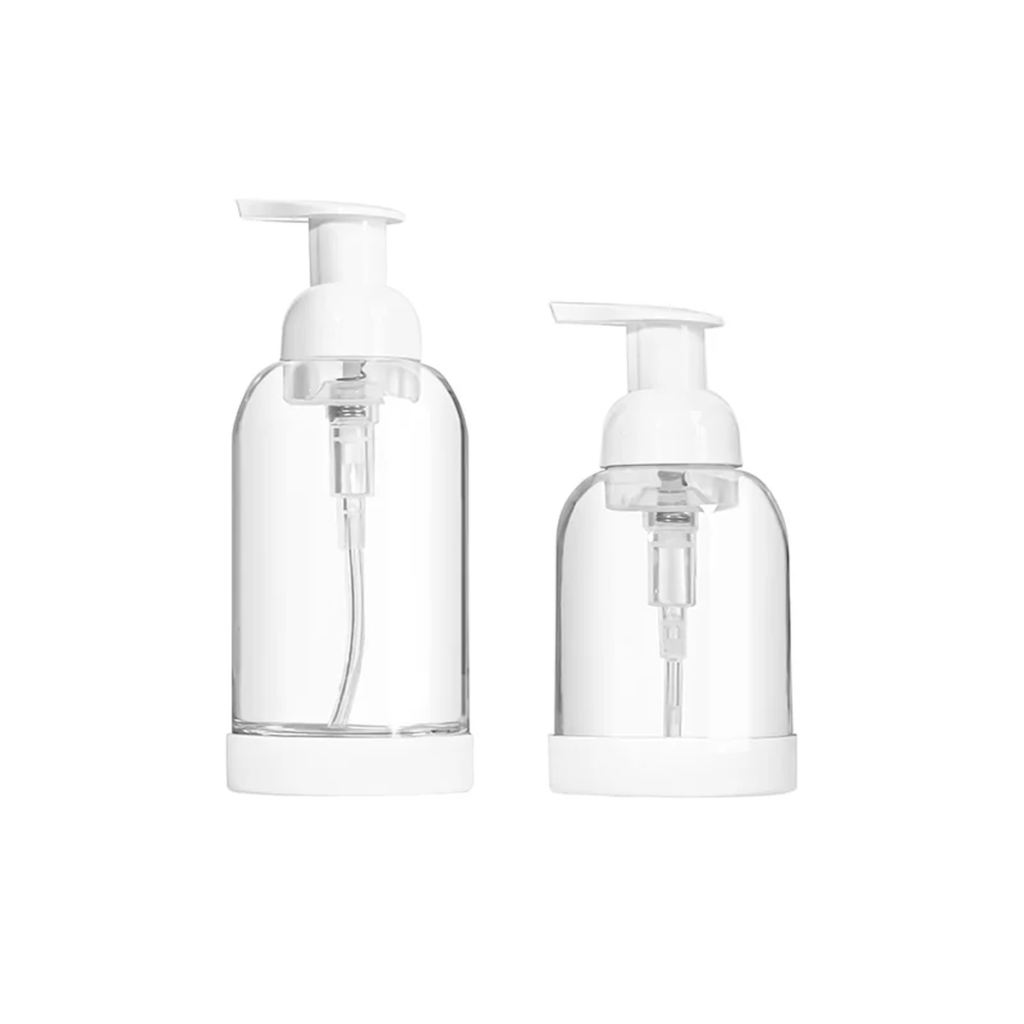
When to choose it: This clear glass dispenser is a good choice for a bright, coordinated bathroom. The transparent bottle makes the remaining liquid easy to see, while the white pump pairs neatly with white basins, pale countertops, and matching accessories. Paired with a suitable foaming-soap refill, the pump delivers foam directly into the hand. Choose it when you want visible refill levels and foaming output in one glass bottle; choose a compatible liquid-pump model if you want to keep using ordinary liquid hand soap.
- Bottle and pump: Clear glass with a white foaming pump.
- Selected style: Taller / White, shown on the left.
- Capacity: 350 mL.
- Single-bottle price: US$3, including the white foaming pump and pictured base sleeve.
- Purchase quantity: One Tall bottle can be ordered; the photograph also shows a shorter alternative.
Product and order inquiry: View the Taller / White style and request a quote or sample at MimoPackage.
For a Wholesale Project Order
The Amber / Gold offer below is a different purchase decision: compare it when equipping a project or placing an order that meets its minimum quantity.
Mimo Amber Round-Shoulder Dispenser
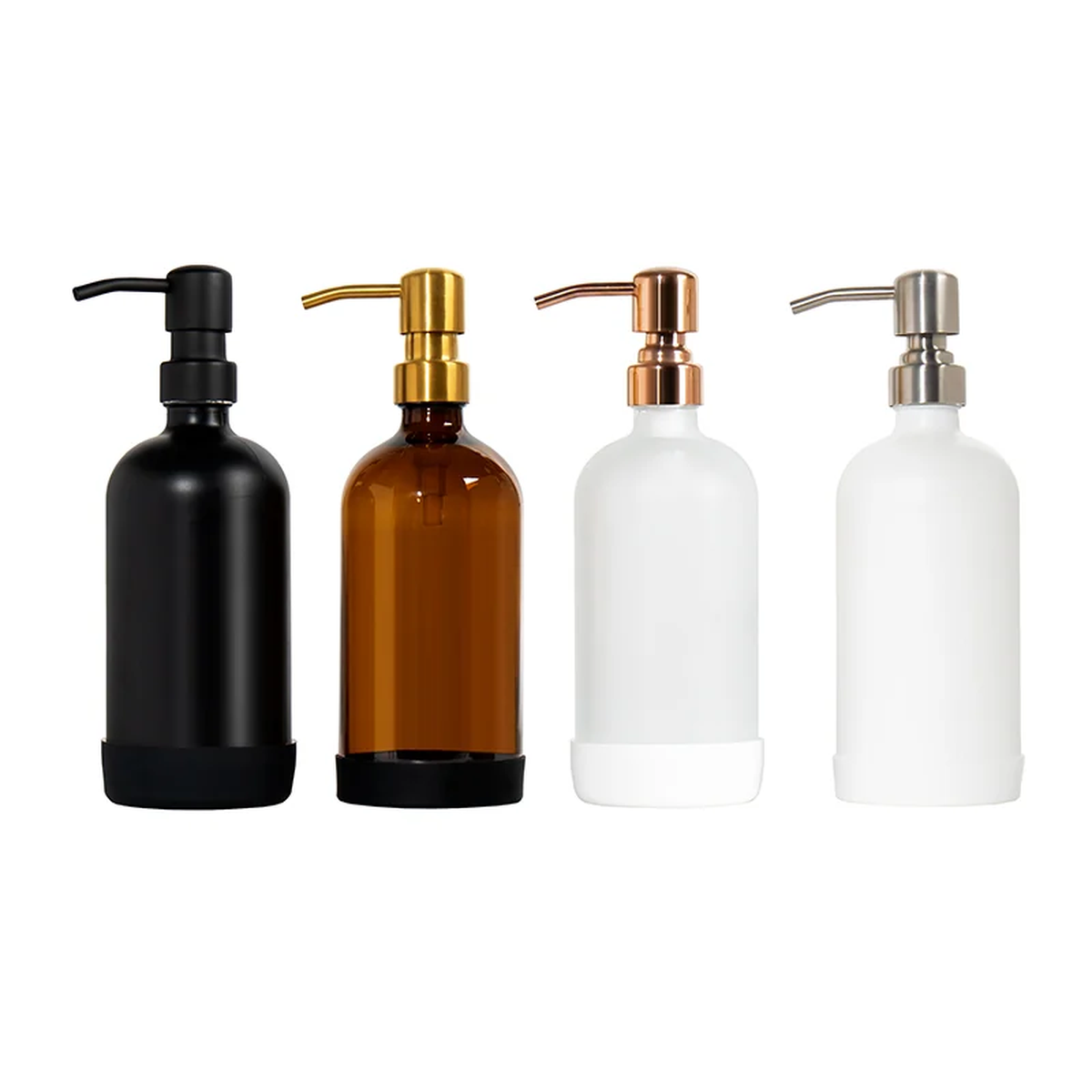
When to choose it: This amber-and-gold dispenser is a good match for wood cabinetry, warm-toned stone, and gold bathroom fittings. Its rounded shoulders give it a soft, classic outline. The included latex anti-slip base sleeve adds grip between the bottle and countertop, helping reduce sliding during pumping. It also cushions contact when the bottle is set down, making the base sleeve a practical addition to the decorative design.
- Bottle and pump: Amber glass with a gold-colored liquid-pump exterior.
- Capacity: 500 mL.
- Base: Latex anti-slip sleeve included.
- Wholesale price: US$2 per dispenser.
- Minimum order quantity: 100 units.
Wholesale inquiry: View the Amber / Gold style and request a quote or sample at MimoPackage.
Purchase fit: The US$2 unit price applies to the 100-unit wholesale offer described here. Choose this route for a project that can use that quantity; it is not a US$2 single-bottle retail offer.
Choose the product that meets your refill, space, operating, and care requirements first; use appearance and price to decide between the options that remain.