How to Choose a Kitchen Soap Dispenser
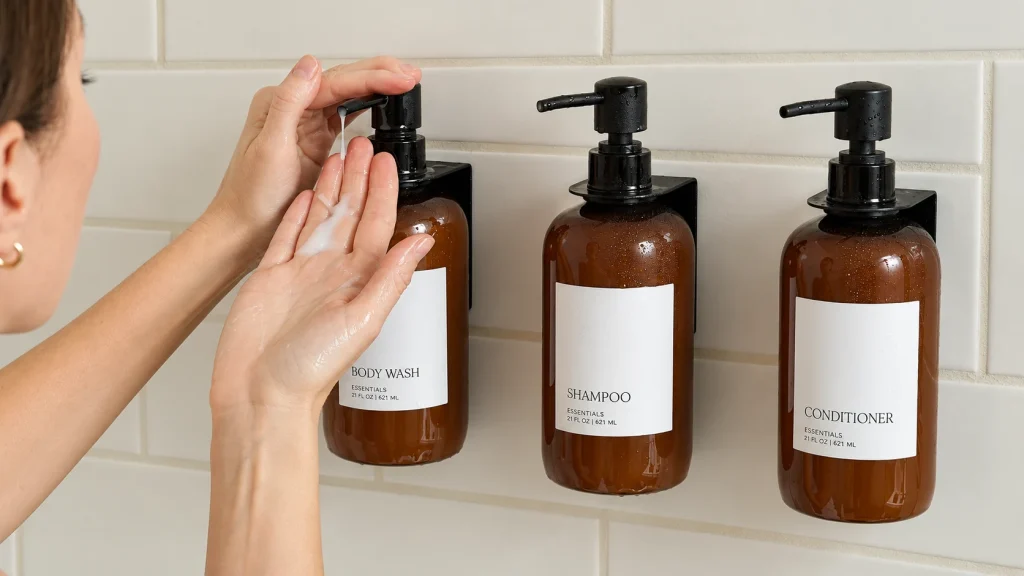
Choose a kitchen soap dispenser that works with your soap, delivers it naturally to your hand or sponge, and stays steady in the space beside your sink.
Then compare how you will refill it, deal with drips and wipe it clean. A finish that suits the kitchen is worth choosing once those everyday actions work for you.
The right combination may be a simple hand-soap bottle beside a separate dish-soap dispenser. Matching bottles can look tidy, but the two liquids do not need identical pumps or capacities.
Kitchen vs. Bathroom: What Changes in Daily Use?
A bathroom dispenser can also suit a kitchen when its job stays the same. Compare your routines with these examples, rather than assuming one room is always wetter or busier.
| Everyday situation | At a bathroom handwashing basin | At a kitchen sink | What to choose for |
|---|---|---|---|
| Receiving the soap | A hand receives hand soap. | A hand, sponge or brush may need soap. | An outlet and action suited to the receiving object. |
| Touching the pump | A reachable press head may be sufficient. | Hands may hold a sponge or be covered in oil or dough. | A press action you can manage, or a suitable sensor system. |
| Wiping the dispenser | Water marks and soap residue need attention. | Food residue and grease may join the splashes. | Surfaces and joints you can reach with a cloth. |
| Using it repeatedly | Consumption follows handwashing habits. | Food preparation and washing dishes may use the two liquids at different rates. | Capacity based on actual consumption, rather than room name. |
| Fitting it beside the faucet | It shares space with basin accessories. | It may also share space with sponges, brushes and dishes. | Room for the complete setup and the hand using it. |
Start with the Soap You Use and Where You Need It
For handwashing, choose a dispenser that puts compatible hand soap into your palm; for washing dishes, choose one that delivers compatible dish soap to your sponge, brush or other intended target.
This choice determines what the pump must handle and what needs to fit beneath its outlet.
If you keep both liquids by the sink, use separate, clearly identified containers. Labels such as “Hands” and “Dishes” are useful even when the bottles match. You can also pair a hand-soap pump with a different dishwashing design instead of making both jobs fit one bottle style.
Decide whether you want liquid or ready-made foam:
- Liquid: a liquid pump dispenses the soap as liquid.
- Foam: a foaming system combines a suitable formula with air. Compatible foaming dish-soap systems exist, so foam is an option for washing dishes as well as handwashing.
For foam, choose the matching dispenser and refill. Diluting an arbitrary dish soap is not a universal way to make it work in a foam pump.
Liquid versus foam describes the soap and output. Manual versus sensor describes how you trigger it. Keeping those choices separate makes it easier to find a dispenser that supports both your refill and your preferred action.
Choose a Setup That Fits Your Sink and Stays in Place
Choose a movable countertop dispenser to avoid installation, or a built-in model to move the reservoir below the counter when you have a suitable mounting hole and space underneath.
Whatever the mounting method, leave a clear route for your hand or sponge to reach the outlet. A countertop bottle can move with you for refilling or wiping the counter; a built-in model leaves only the pump above it.
Countertop: check support, stability and space
- Support and sliding: put the whole base on a flat supporting surface. You should be able to reach the press head without pushing the bottle toward the sink edge. A gripping pad or sleeve can help reduce sliding during a press.
- Resistance to tipping: consider the base, the bottle’s balance and where the force lands. A heavy bottle or rubber-like base alone does not establish both resistance to sliding and resistance to tipping.
- Complete footprint: include the spout, sponge holder and tray when comparing space. Leave room for the dispensing action as well as the product itself.
Width comparison: the OXO sponge dispenser below is about 13.8 cm wide, close to the 14.2 cm width of the simplehuman 14 oz pump-and-caddy setup. The OXO is much lower, but that does not make its sideways footprint much smaller.
Built-in: check the mounting hole and access below
A built-in option: Moen 3942 in Chrome
The Moen 3942 is a liquid soap/lotion dispenser and a useful choice when you have a compatible hole and want the soap reservoir out of sight. Its 18 oz bottle refills from above, so ordinary refilling does not require reaching into the cabinet to unscrew it.
Dish-soap compatibility: the match with your particular formula still needs to be established; the available product information does not confirm that compatibility.
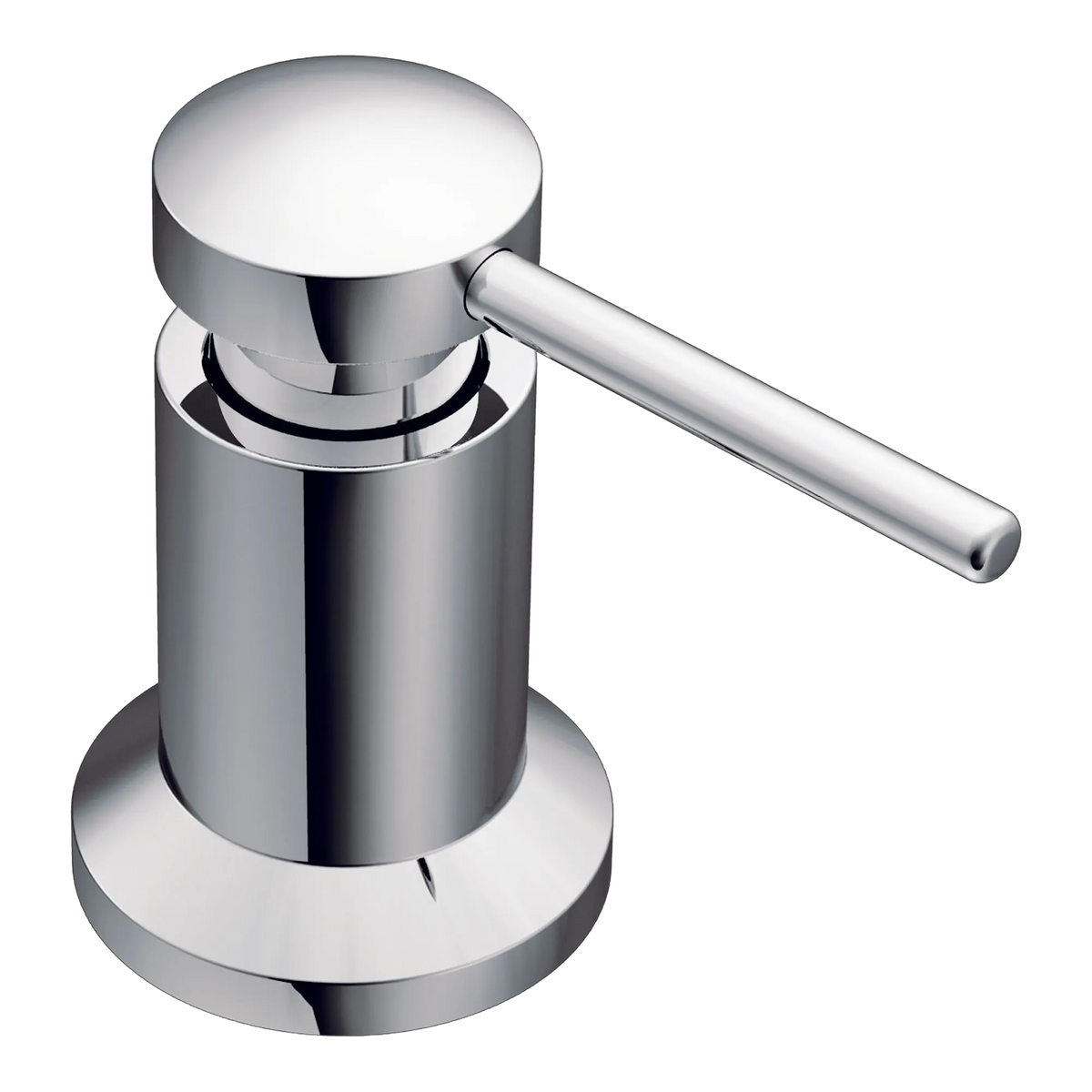
Its installation dimensions answer different fit questions:
| Moen 3942 requirement | What it means beside your sink |
|---|---|
| One 1-1/8 in mounting hole | The existing hole must suit this model. |
| Maximum deck thickness of 2-1/4 in | The mounting assembly must reach through your counter or sink deck. |
| Spout reach of 2-3/4 in, from centerline to outlet | The hole position must put the outlet where your hand or sponge can receive soap. |
| Below-counter bottle diameter of 2-11/16 in | The reservoir must clear the sink bowl, pipes and other fittings. |
| 11-13/16 in from the counter’s upper surface to the bottle bottom | This is the specified vertical reference; it is not a measurement starting at the underside of the counter. |
Removal access: you also need to reach, unscrew and remove the bottle when it needs attention. A reservoir that fits between pipes while installed may still be awkward to take out.
Choose a countertop design if the hole position, deck thickness or access makes the built-in arrangement inconvenient.
Price and channel: US$51.69 on the Moen US product page, checked November 5, 2026; taxes and shipping are not included in this price comparison.
Wall-mounted: allow for fixing, refilling and removal
Wall mounting can free counter space if you can use suitable mounting hardware and accept the extra handling.
- Fixing and bottle fit: in one screw-mounted bottle-holder design, an upper ring locates the bottle neck and an adjustable lower support carries the base. Its screws and wall anchors must suit the wall material, and the bottle must fit the holder.
- Refill clearance: leave room above a screw-pump bottle to unscrew and lift out the pump and dip tube.
- Bottle removal: support the whole bottle while releasing the lower support to take it out for cleaning.
If you cannot install the required hardware or prefer simply to lift the bottle away, a compact countertop dispenser is the more practical choice.
Choose a Pump for Easy Dispensing and Reliable Sealing
Choose an action you can manage naturally with your hand or sponge, then check liquid compatibility, maintenance and the separate places where leaks or drips can occur.
Match the action to what you are holding
| Design | How you take soap | When the action makes sense |
|---|---|---|
| Ordinary press head | Press the head while positioning your hand or sponge under the spout. | You prefer no charging, can reach both positions naturally and keep the base supported during the press. |
| Sensor dispensing | Bring your hand or sponge into the model’s dispensing zone below the outlet. | You want to avoid pressing with a dirty hand or while holding a sponge, and accept charging and sensor care. |
| Press-down sponge platform | Press the sponge down on the platform to put dish soap directly into it. | The sponge is your main dishwashing tool, and you want to dispense where it is stored. |
The sponge platform is itself a manual design. Its advantage is combining the pressing and receiving positions, while a sensor removes the pressing action. Neither distinction establishes that one design is universally more hygienic or uses less soap.
For dispensing straight into a sponge: OXO Good Grips Soap Dispensing Sponge Holder, Matte Black, 12426800
Pressing a sponge onto the upper platform delivers dish soap directly to it, so you do not need to put the sponge down and pick up a bottle of dish soap. The raised platform also holds the sponge between uses, and the clear reservoir lets you see the remaining soap.
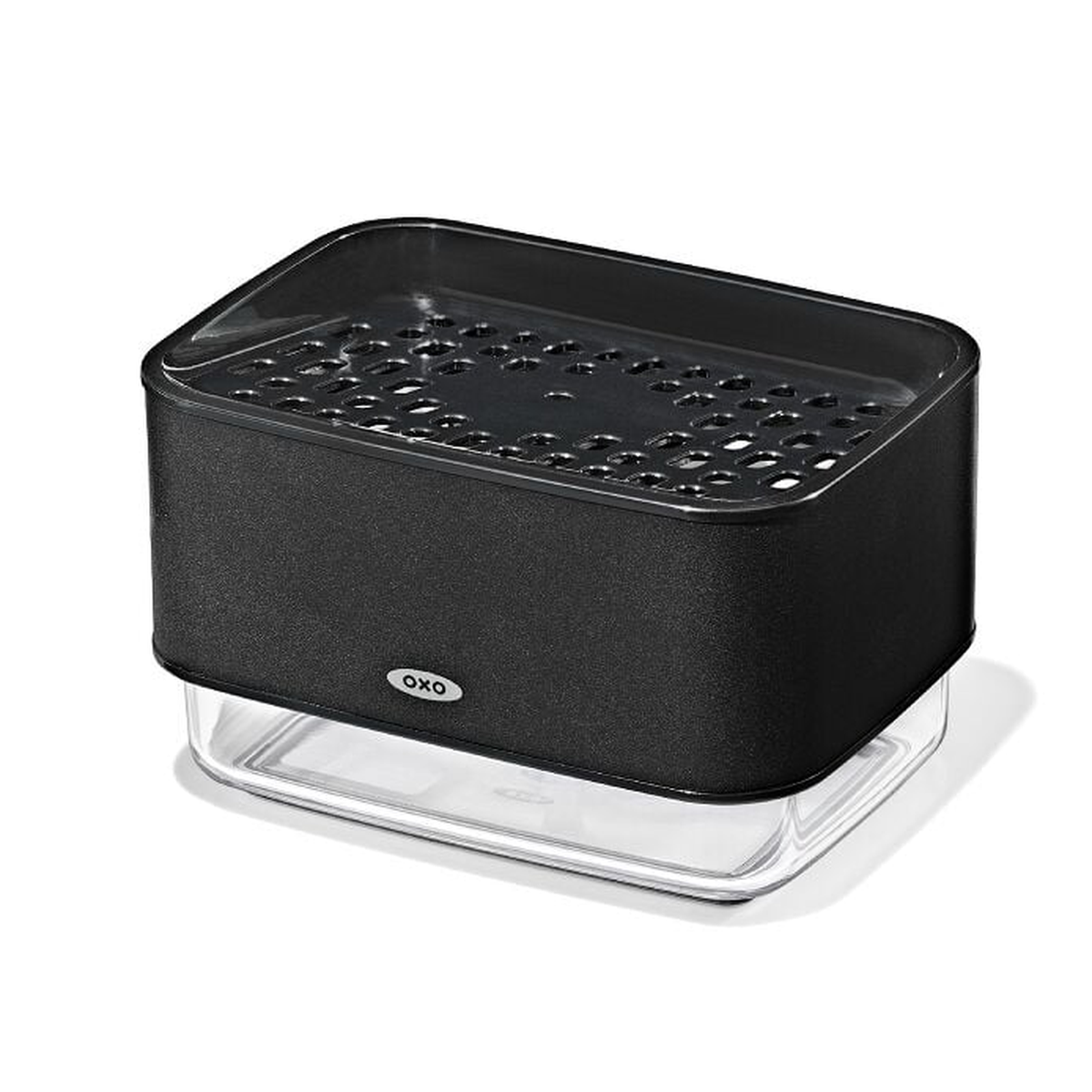
Dimensions: approximately 13.8 × 10 × 8.3 cm (width × depth × height).
Reservoir capacity: not published in the official specifications checked.
- Best fit: sponge dispensing and storage belong in the same place beside your sink.
- Choose a projecting spout instead: you mostly fill your palm or apply soap to a brush.
- Care to accept: empty the water tray and hand-wash the removable parts.
Price and channel: US$24.99 at OXO US, checked November 5, 2026. This price and configuration are for the Matte Black model.
For dispensing without a press: simplehuman Sensor Pump Dish, 14 oz, Brushed, ST1077
This liquid sensor pump suits someone who wants to bring a sponge or hand beneath the outlet and receive soap without pressing a head.
It varies the amount with receiving distance: nearer gives less, farther gives more. That gives you a way to adjust the dose through your normal receiving action, rather than a fixed amount you must accept every time.
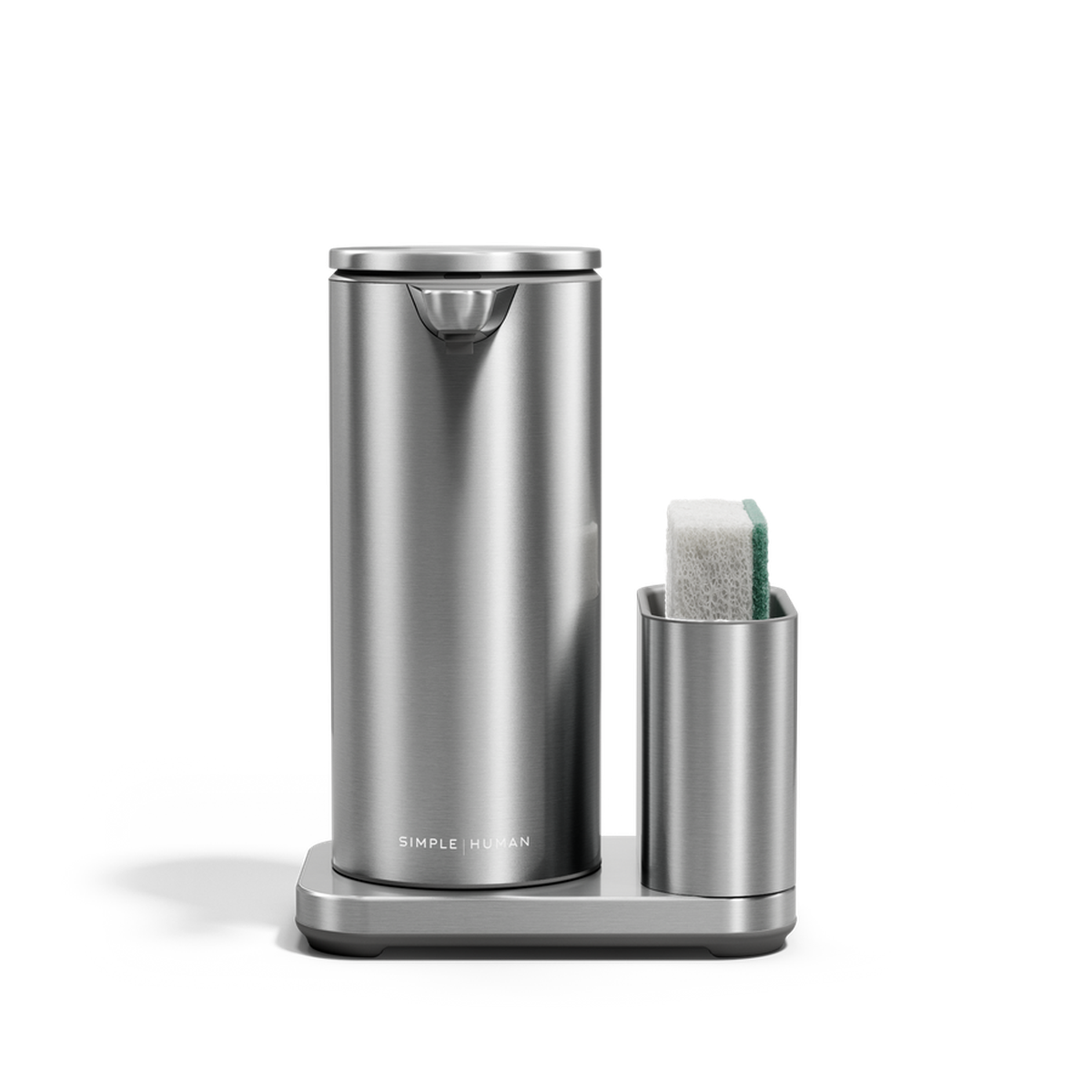
Capacity: 14 US fl oz.
Complete dimensions: the pump with caddy measures 14.2 × 13.7 × 19.7 cm (width × depth including the spout × height).
Charging: its built-in battery uses a magnetic charging base; the manufacturer specifies up to eight months per charge.
Choose it if that charging task and the space for the caddy are worthwhile in exchange for avoiding the press.
Refill compatibility: use compatible liquid hand or dish soap without exfoliating particles. This is an open-refill liquid system, rather than a dispenser requiring a proprietary replacement cartridge.
Routine care: the sensor window and outlet still need accessible wiping, so touch-free dispensing does not remove routine care.
Price and channel: US$120 for the Brushed version at simplehuman US, checked November 5, 2026. Other finishes can have different prices.
Choose a pump you can keep using
For frequent use, give priority to a complete pump-and-bottle combination that permits your soap, has a workable cleaning method and offers a clear route to replacement parts.
A shiny head or a “metal-free” description tells you less about that combination than it may first appear.
Manual pumps can use stainless-steel springs. Compare the return mechanism and whether the spring contacts the soap:
- Metal spring in a dry chamber: some designs keep the soap away from the spring in this way. A pump with a metal-free liquid path can therefore still have a metal spring elsewhere.
- All-plastic return mechanism: this removes the metal spring itself as a possible corrosion source.
These are useful construction differences, but formula compatibility, return action and the rest of the pump still matter. They do not establish a universal lifespan ranking.
Replacement parts can let you keep a sound bottle or an existing installation. The Moen 3942 has separate head and underdeck service kits, giving a model-specific replacement path.
For a separate replacement pump, check three parts of the match:
- Dispensing system: the replacement pump’s dispensing system must suit the bottle.
- Neck connection and seal: both must work with the bottle. A matching diameter alone is insufficient.
- Dip-tube length: the tube must reach low enough to draw soap without its inlet being pressed against the bottom.
Separate neck leaks, outlet drips and accidental presses
| Problem | What to choose | Limits |
|---|---|---|
| Leakage at the bottle neck | A matching bottle and pump whose connection and sealing surfaces work together. Where a gasket is used, it needs the right fit and assembly. | A gasket does not make unrelated bottle and pump parts compatible. |
| Soap dripping from the outlet | A drip-control design for soap left at the spout. The simplehuman 14 oz model uses a silicone valve designed to reduce drips. Keep the outlet accessible for wiping dried residue. | The valve does not seal the bottle neck or establish a never-drip guarantee. |
| Accidental presses during moving or storage | A lock to prevent unintended presses; it matters more if you often move the dispenser than if it stays beside the sink. | A locked head alone does not establish that a filled bottle is suitable for upside-down transport. |
Choose a Bottle Material That Suits Your Kitchen
Choose transparent glass or plastic, or a dispenser with a level window, to see the remaining soap; choose opaque ceramic or plastic if you want its color to stay the same when you change refills.
Then narrow the choice by how the complete dispenser feels when filled, where it will sit and how it relates to the sink and fittings.
Glass: let the bottle and liquid share the appearance
Clear glass makes the liquid’s color part of the display. Amber glass adds a warm brown tone that can sit comfortably beside wood cabinets, beige countertops and warm metal details. How easily you see the level will also depend on the liquid, label and light.
Placement: Glass makes more sense in a supported position away from frequent knocks than on a crowded edge. Its placement and the consequences of a fall matter more than the room label alone, so glass can still be a reasonable kitchen choice.
Handling: If you move the bottle often to refill or wipe underneath, consider the complete filled assembly and your grip.
For a coordinated bulk order: Mimo Amber / Gold 500 mL dispenser
The amber round-shoulder bottle and gold-finish pump suit a warm palette, especially where you want to repeat wood tones and gold hardware. This selected configuration includes a black latex base sleeve, which adds a gripping contact layer beneath the glass and helps reduce sliding during a press.
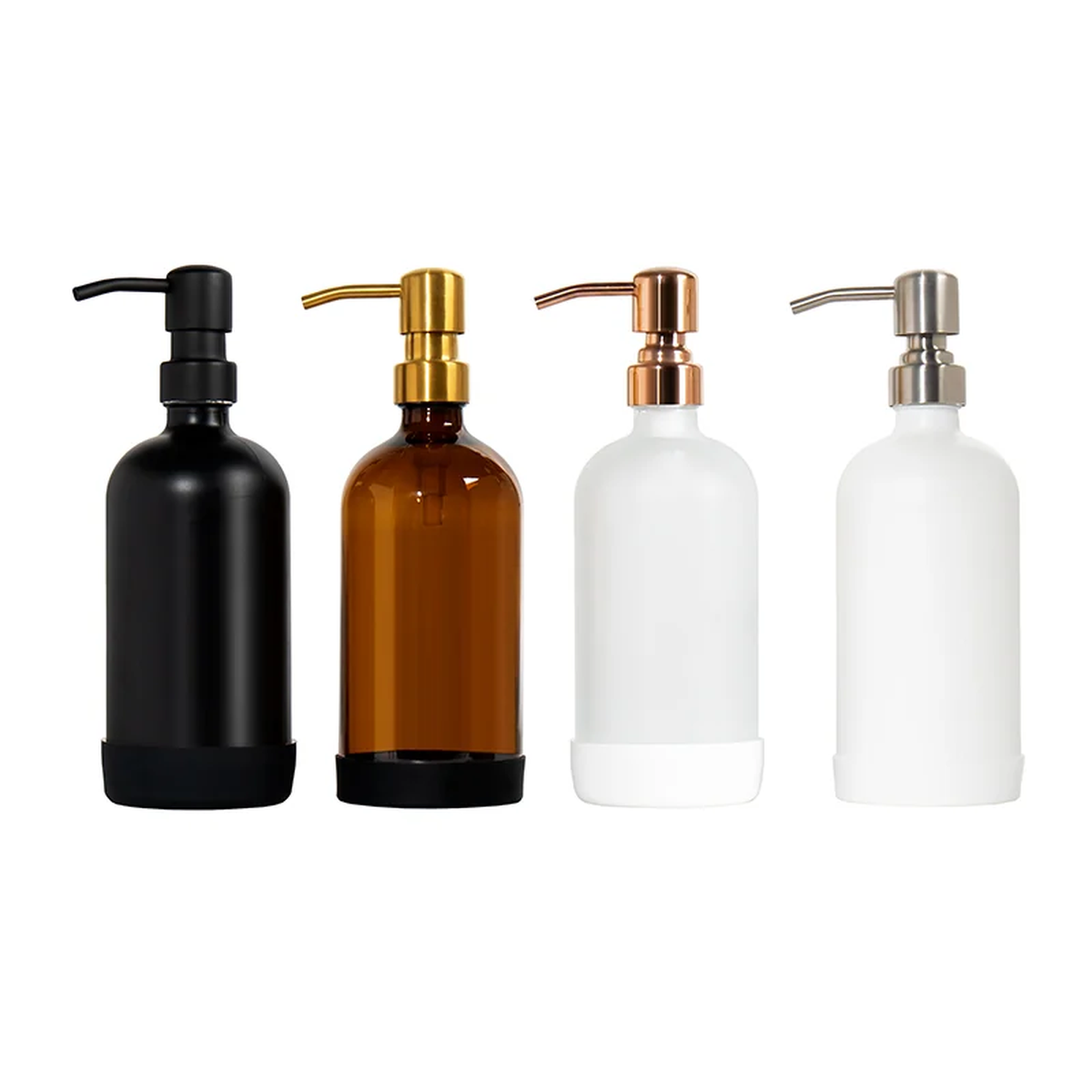
- Configuration: The 500 mL Amber / Gold single-bottle configuration suits buyers arranging a coordinated batch.
- Wholesale terms: US$2 per dispenser, minimum order 100, based on the price provided for this configuration on November 3, 2026. Freight and tax terms are outside that information. This is a wholesale option, rather than a single-unit retail price.
- Sample or quote: Use the Mimo Amber / Gold configuration page. Request a sample to check the intended refill match; compatibility with a particular hand-soap formula or dish soap has not been established here.
Ceramic and stoneware: keep a consistent block of color
An opaque body hides the liquid, so a different refill does not change the dispenser’s visible color. An off-white glaze can pick up a pale sink or tile; charcoal can repeat dark faucets or accessories. Shape and finish can connect the dispenser to a ceramic utensil holder or other items already beside the sink.
Checking the level: Without a level window, you lose the direct view available through a clear bottle. Choose this appearance if opening the container to check the level, or refilling according to your own usage, is an acceptable trade.
Refilling: Compare the actual opening and grip. Ceramic dispensers can have lift-out or screw-in pump assemblies, so the material alone does not determine the refill action.
Plastic: compare easy handling and the appearance you want
Plastic offers both clear reservoirs that show the level and opaque bodies that hold a fixed color. White, black or transparent designs can fit a coordinated kitchen just as deliberately as other materials.
Frequent lifting: If you often lift the dispenser to wipe the counter or move it for refilling, a lightweight configuration is worth considering. Compare the complete product and its filled weight, though: a large plastic dispenser with accessories need not be lighter to handle than every smaller alternative.
BPA-free labeling: If this is part of your buying criteria, choose a product that explicitly carries the label. It does not establish soap compatibility, heat resistance or dishwasher suitability.
Metal: coordinate with the sink and fittings
A brushed finish can echo a stainless-steel sink, while a polished finish can repeat a chrome faucet. A metal exterior can also be combined with a clear level window, giving you a view of the soap without switching to an entirely transparent bottle.
Parts that touch the soap: Distinguish the outer shell from the reservoir and pump internals. A steel-looking exterior does not establish what the liquid touches.
If level visibility is your priority, compare the window with clear glass and plastic; if a fixed color matters more, compare opaque metal, ceramic and plastic by their actual shape, finish and handling.
Match Capacity and Refilling to How Much Soap You Use
A larger reservoir is useful when it reduces refilling enough to justify its space.
Judge it against your own soap consumption and the dimensions of the complete setup. If you use dish soap much faster than hand soap, the dish-soap reservoir can be larger even when the two dispensers look coordinated.
Compare capacity with the whole footprint
These current simplehuman designs show why capacity alone does not describe fit. The smaller pump is included here as a size comparison; the 14 oz unit includes sponge storage as well as more soap.
| Configuration | Capacity | Complete width × depth including spout × height |
|---|---|---|
| Liquid Sensor Pump, ST1082 | 9 US fl oz | 2.8 × 4.4 × 6.4 in |
| Sensor Pump Dish with caddy, ST1077 | 14 US fl oz | 5.6 × 5.4 × 7.75 in |
Extra capacity: The second setup holds 5 fl oz more, about 56% extra capacity.
Extra space: It adds 2.8 in of width, 1 in of depth and 1.35 in of height. Part of that extra width accommodates the caddy.
The space trade-off depends on what is already beside your sink:
- If it replaces a separate sponge holder: the larger setup can be worthwhile.
- If you already have a holder and only a narrow gap remains: the smaller standalone format may fit better.
For a refill estimate, use the amount you actually put in and your average daily use:
Estimated days between refills = usable soap filled (mL) ÷ average daily use (mL/day).
The following quantities are assumptions for illustration, not household averages:
- At 20 mL a day: 400 mL of usable soap lasts about 20 days.
- At 10 mL a day: the same 400 mL lasts about 40 days.
Equal-size reservoirs can therefore need refilling at very different intervals.
Choose an opening that works with your refill packaging
Pouring into the bottle: A wide opening gives you a larger target when pouring from a bottle or pouch. With a narrow-neck bottle, a controlled pouring spout or funnel can make the transfer easier.
Taking out and resting the pump: A screw-off pump leaves you handling a soap-coated dip tube while you pour. A lift-out head changes that opening action, but still needs somewhere to rest.
A clear wall and a MAX line solve different problems:
- Clear wall: helps you see when soap is running low.
- MAX line: tells you when to stop filling.
Choose the features that help with the refill action you actually find awkward, rather than treating “easy refill” as a single feature.
Refilling a hidden reservoir: The Moen’s top-fill arrangement avoids removing the below-counter bottle for each refill, but you cannot watch that hidden reservoir from the side as you pour.
Allow for the soap already inside: an 18 oz maximum capacity is not an instruction to add another 18 oz each time.
Choose a Design That Is Easy to Wipe and Clean
Choose a dispenser whose greasy or soapy surfaces you can reach with a cloth, whose reservoir and liquid path have an allowed cleaning method, and whose accessories can be emptied and cleaned.
The question is whether you are willing and able to carry out those actions regularly. Access matters for the bottle itself; the pump, sensor and accessories also need care suited to their particular parts.
Reach the bottle’s outside, base and interior
Outside surfaces: A smooth side lets a cloth pass continuously across it. Deep grooves, raised decoration, label edges and sleeve joints add places the cloth must reach separately. If you like those details, leave room to get around them.
Under the base: You need to lift the bottle to wipe underneath. A visible base sleeve does not by itself establish that it can be removed for washing.
Inside the reservoir: A wide mouth helps access, but a brush must also reach the bottom and turn against the shoulders. A narrow opening or deep shoulder can restrict that movement. If the product is designed for rinsing instead, judge whether its permitted method suits you; a refillable bottle is not necessarily convenient to brush out.
Follow the care method for the pump and sensor parts
Being able to remove the pump does not mean its internal mechanism can be dismantled. These care methods apply to the specified models and parts; other pumps have different limits.
| Model | Part | Cleaning method |
|---|---|---|
| Moen 3942 | Specified pump-and-tube assembly | The instructions allow warm soapy water and pumping water through the assembly. |
| simplehuman 14 oz sensor model | Sensor window | Rubbing alcohol and a microfiber cloth are recommended for wiping. |
| simplehuman 14 oz sensor model | Outlet with dried soap | Wipe gently. |
Waterproof wording is not permission to soak the whole device.
Empty and clean sponge holders and water trays
The OXO combines sponge support with parts that separate and collect runoff:
- Support and separation: Its raised platform supports the sponge, and its internal cap keeps runoff separate from the soap.
- Emptying the tray: The tray collects water that you must pour out.
- Allowed care: Its removable parts are hand-wash only, with no bleach or dishwasher cleaning.
An ordinary decorative tray groups bottles and catches residue, but does not provide the same sponge support or water separation.
The most useful dispenser is the one whose compromises suit your routine: a stable press bottle for simple dispensing, a sponge platform for washing dishes, a sensor for fewer press actions, or a built-in pump for less bottle space above the counter.
Once the liquid, receiving action and placement fit, choose the capacity, care routine and finish you will be happy to live with.