Glass vs. Plastic vs. Ceramic vs. Stainless Steel Soap Dispensers: Practical Differences and How to Choose
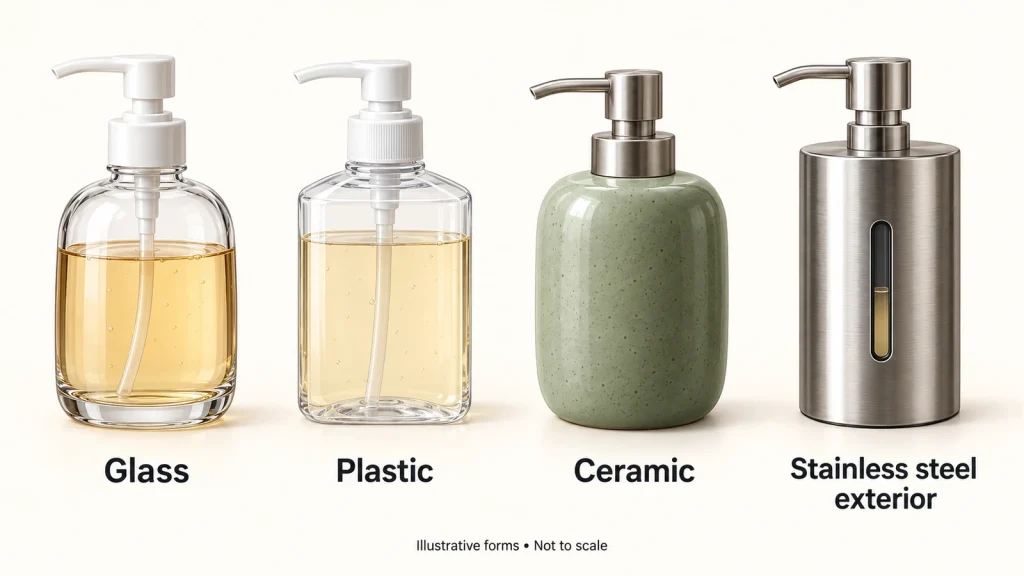
A soap dispenser can look right beside the sink and still be awkward to live with. You might like a solid ceramic color but miss being able to see the soap level. A clear glass bottle solves that problem, yet raises a different concern when it is lifted over a tiled floor.
Material changes those everyday trade-offs. It does not, by itself, determine whether the pump is easy to press, the bottle stays in place, or a refill goes in cleanly. Those results also depend on the base, opening, pump and surface finish.
For refillable, manually operated countertop dispensers, the useful comparison starts with what the material actually does—and which parts of the product use it.
What the four material labels actually describe
A dispenser has a reservoir that holds the soap, an exterior you see and touch, and a pump that moves liquid to the spout. The reservoir and exterior may be the same part, as in a simple glass bottle. Other designs combine an outer shell, a separate container and a pump made from several materials.
| Material | Forms you may encounter | The practical distinction |
|---|---|---|
| Glass | Clear, colored, frosted or surface-coated bottles | Clear glass exposes the contents; color, frosting and coatings change visibility and care requirements. |
| Plastic | Polyethylene terephthalate (PET) refill bottles; polypropylene (PP) and polyethylene (PE) containers; clear, translucent or opaque designs | Transparency, flexibility and impact behavior vary with the polymer and construction. “Plastic” is not one uniform specification. |
| Ceramic | Stoneware containers with glaze, sometimes with an additional surface coating | An opaque body gives a solid visual finish, but the glaze and coating are also part of the surface being cleaned. |
| Stainless steel | Metal containers or metal exteriors combined with other materials, sometimes with a level window | A steel appearance does not establish what the internal reservoir or pump is made from. A window can make an otherwise opaque design readable. |
A glass bottle can have a plastic pump mechanism; a stainless steel dispenser can include plastic and silicone components. Those combinations are normal construction choices. They matter when you compare cleaning methods, replacement parts or the materials that contact the soap.
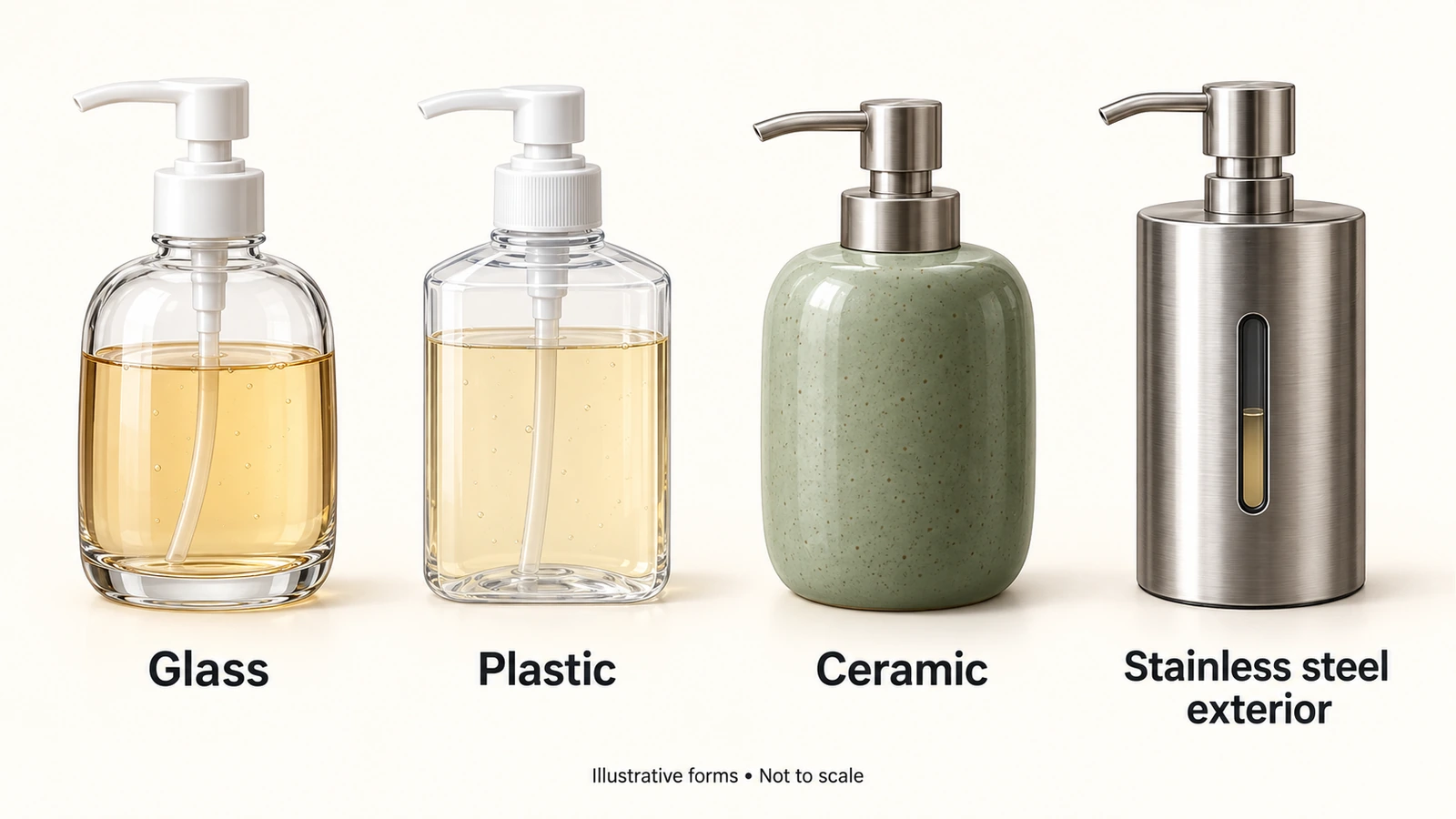
How the materials differ in everyday use
Three separate questions reveal the differences: how the dispenser behaves while you handle it, how easily you can see and refill the contents, and what happens when it is knocked or damaged. These are different jobs, so a good result in one does not settle the others.
Weight, grip and one-handed pumping
Weight can help a dispenser resist movement during use, but it is also weight you carry when lifting the bottle to refill or clean it. Glass and ceramic designs can provide a substantial feel; a plastic bottle may be easier to lift. Neither description establishes the actual weight of a particular product. Wall thickness, size, an added base and the pump all contribute.
Stability also involves the base’s footprint and grip, the position of the pump, and the force needed to press it. A wide base provides a larger support area; a non-slip underside helps resist sliding. An off-center push can still tip a narrow, heavy bottle. Filling the reservoir adds weight, so a dispenser that behaves well when full may move more as it empties.
Wide pump heads and non-slip bases are available features, including on stainless steel exterior designs. Their usefulness comes from the construction, not simply from the metal label. When one-handed operation is your priority, compare the base and the actual pump action, including near-empty use, rather than choosing the heaviest-sounding material.
Seeing the level and getting a refill inside
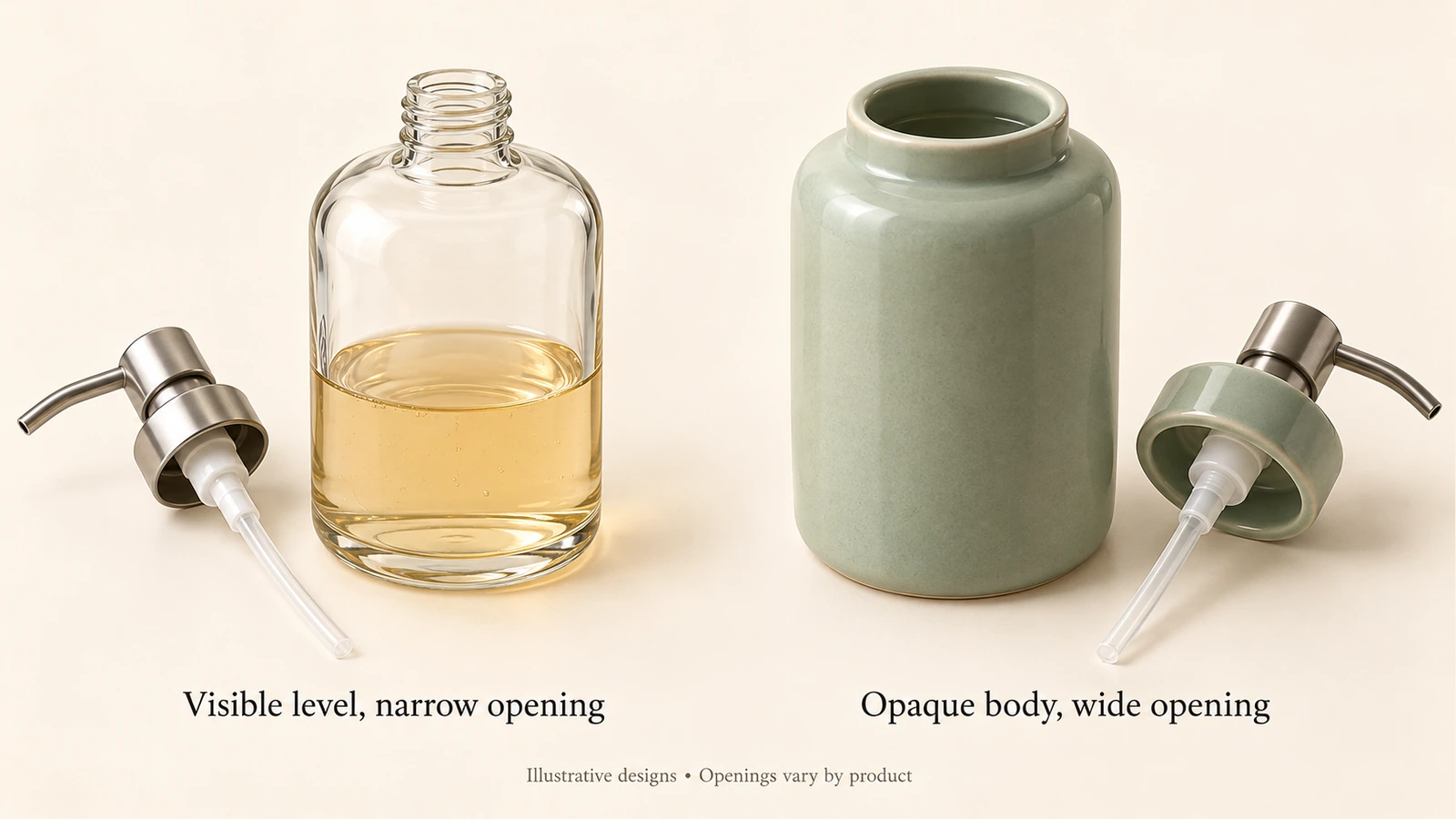
Clear glass lets you see a broad area of the contents. Clear plastic can do the same: PET can be transparent, while polyethylene bottles may be translucent or opaque. Color, labels and coatings can reduce visibility in either category.
Ceramic walls and uninterrupted metal walls hide the liquid level. A stainless steel exterior with a transparent window offers a different solution: the body keeps its metallic appearance while the window provides a visible level. Without a window or another indicator, an opaque reservoir needs to be opened to inspect what remains.
Visibility brings an appearance trade-off. A clear bottle displays the soap’s color and any residue visible through the wall; an opaque bottle keeps its own color regardless of the contents. Choose between displaying the liquid and concealing it, rather than treating transparency as an automatic upgrade.
Refilling is a separate question. A wide opening gives you more room to aim the refill stream. A visible level or fill line helps you stop at the right point. A clear bottle with a narrow neck can offer good observation but awkward filling; an opaque bottle with a removable wide lid can offer the reverse.
Chips, cracks, dents and pump failures
Glass and ceramic are hard, brittle materials. Hardness helps explain resistance to some surface wear; it does not mean the container will survive a fall. A damaging impact can start or extend a crack, chip an edge or break the reservoir into pieces. That consequence matters around hard sinks and tiled floors, especially where the dispenser is often lifted or knocked.
Plastic requires a more specific comparison. Bottle-grade PET and polyethylene can offer useful impact resistance, but different polymers, wall designs and conditions produce different results. Plastic can still scratch, deform, split or crack. A thin refill bottle and a thick decorative dispenser should not be assumed to behave alike merely because both are plastic.
A steel reservoir can deform rather than fracture in the brittle manner of glass or ceramic, leaving a dent or scratch. This does not make the complete dispenser indestructible: the pump, joints or any separate inner container can still fail. A steel shell around a glass reservoir also does not remove the possibility of glass breakage.
It helps to distinguish three outcomes. A surface mark changes appearance. A cracked or leaking reservoir can no longer hold soap properly. A failed pump can stop dispensing while leaving the bottle intact. Those problems lead to different replacement decisions.
If avoiding glass or ceramic fragments is your priority, compare suitable impact-resistant plastic or metal reservoir designs—not just products with a metallic exterior.
Cleaning and replacement depend on more than the bottle
Long-term convenience involves three parts of the product: the surface you clean, the components the liquid passes through, and the parts you can replace. Separating them makes maintenance choices more useful than a general claim that one material is “easy to clean.”
Match the cleaning method to the actual surface
Smooth, accessible surfaces are easier to reach with a cloth than deep grooves or tight joints. Transparency may reveal residue inside, while opaque finishes conceal the contents; neither makes the internal cleaning unnecessary.
Actual care instructions illustrate why the finish matters:
- A simple glass dispenser, a PP/PE dispenser and a coated stoneware dispenser can all specify a damp cloth, mild cleaner and drying with a clean cloth for routine external care.
- A removable glass bottle may explicitly permit top-rack dishwasher cleaning while its pump must stay out of the dishwasher. That permission applies to the specified bottle, not to every glass dispenser or its attachments.
- A stainless steel exterior may specify hand washing and drying, with abrasive cloths and strong chemicals excluded. Soap left on the steel parts should be wiped away as directed.
Stainless steel resists corrosion, but is not immune to it. Prolonged contact with chlorine bleach can cause pitting. A product’s steel finish, plastic parts and seals also need compatible care, so treating the whole dispenser like an uncoated metal utensil can create problems.
For convenient cleaning, a removable bottle with an explicitly permitted cleaning method is a concrete advantage. The word “glass,” “ceramic” or “stainless” alone is not that permission.
Follow the liquid path, not the exterior color
Soap is stored in the reservoir, then drawn through a tube and pump before it leaves the spout. These parts can use different plastics, metals and seals. Changing the bottle material does not automatically change the rest of that path.
Consequently, a glass bottle with a metal-looking pump is not necessarily free of plastic contact. Nor does a stainless steel exterior establish better hygiene or compatibility with every soap formulation. The pump and the intended liquid still need to work together; changing the container will not turn a liquid-soap pump into a foaming pump.
For the distinctions between a pump’s outer finish and its working components, see our guide to soap dispenser pump materials and finishes.
Replace the failed part when the design allows it
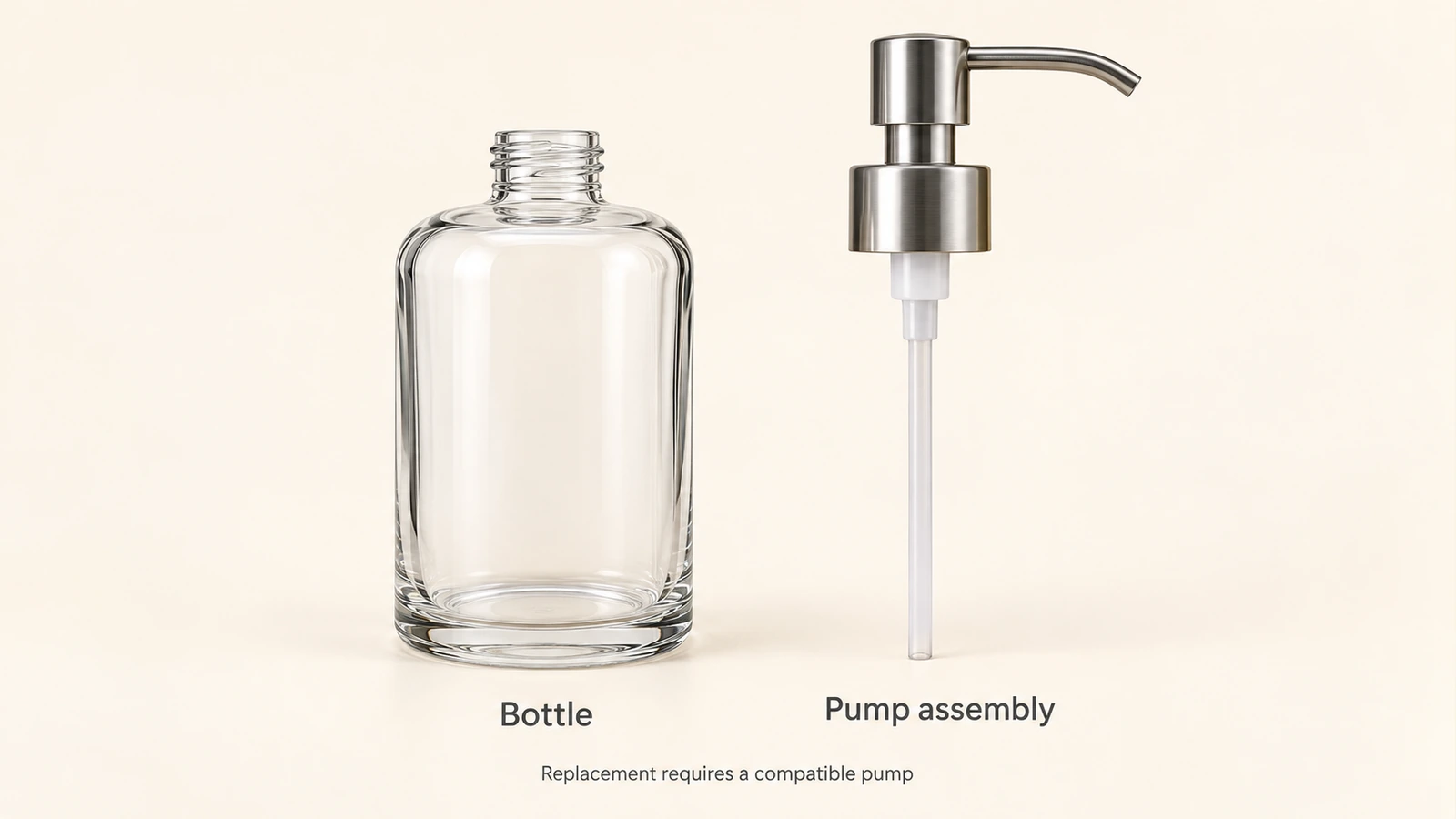
An intact bottle with a failed pump may be worth keeping if a compatible replacement pump is available. A cracked bottle neck or damaged reservoir needs a different remedy: a new pump cannot restore the container.
Designs with separate outer shells and inner containers offer another possible replacement route, but only where the relevant part is actually supplied. Being able to take a product apart does not establish that you can buy the part that fails.
This is why replacement availability belongs in a material comparison. A bottle you want to keep can be more useful when its pump remains replaceable, regardless of whether the bottle is glass, plastic, ceramic or steel.
What do the different materials cost?
The US retail examples below show the listed prices of specific complete dispensers, checked on October 31, 2026. They are individual, empty countertop dispensers supplied with manual pumps—not bulk bottles, soap refills, sensor units or wholesale quotations. Taxes and shipping are excluded.
| Example configuration | Listed capacity | Listed price, USD |
|---|---|---|
| Clear glass with a simple manual pump and wide opening | 7 oz | $2.99 |
| PP/PE plastic with a shaped hand-operated design | 7 oz | $6.99 |
| Stoneware ceramic with colored glaze and a surface coating | 10 oz | $9.99 |
| Stainless steel exterior with a wide pump head, level window and non-slip base | 350 mL | $17.00 |
| Glass bottle with a choice of metal-finish pump styles | 16 fl oz | $22.50 |
| Stainless steel, plastic and silicone design with a soft pump surface, window and non-slip base | 12 oz | $25.99 |
Capacities follow the listings’ volume labels. These examples have different sizes and designs; their prices are reference points, not typical market ranges for each material or a controlled test of the material premium.
Two useful distinctions emerge. First, the two 7 oz examples show that plastic is not automatically cheaper than glass. Second, the two glass examples are different purchases: a small, simple dispenser and a larger bottle with a choice of pump styles. The glass label alone cannot explain their price gap.
Extra spending may buy a larger capacity, a preferred finish, a different pump shape, a visible level or a better-suited base. Compare which features are actually included. The examples do not establish that a higher price buys longer life, a lower pressing force or a particular improvement in durability.
Replacement costs can also be concrete. In one compatible glass-dispenser system, the complete 16 fl oz unit was listed at $22.50 and a replacement manual pump at $11.50. Keeping an undamaged bottle can therefore avoid buying the full unit again. The pump still has to fit that bottle, and shipping may change the saving; a replacement pump can cost more than a different budget dispenser.
Choose the capacity, pump operation and finish that suit you; material alone is not a reliable measure of value.
Choose by the trade-off that matters at your sink
The most useful first decision is which outcome matters most. The second is whether the complete design preserves that benefit without introducing a drawback you cannot accept.
| Your priority | A useful starting choice | Why—and what changes the choice |
|---|---|---|
| See the soap level without opening the bottle | Clear glass or transparent plastic; a windowed design if you want metal | Visibility solves the problem directly. Dark coloring, coatings or large labels can obscure it. |
| Reduce the consequences of brittle breakage | A suitable impact-resistant plastic or non-brittle metal reservoir | Avoiding a glass or ceramic reservoir removes that particular source of fragments. Pump and joint damage remain possible; a metal exterior alone is insufficient. |
| Create an opaque color or glazed finish | Ceramic, compared with other opaque finishes you like | The contents stay visually hidden. Accept the loss of direct level visibility and the breakage consequences of a brittle container. |
| Coordinate with metal fixtures while keeping the level visible | Stainless steel exterior plus a usable level window | Appearance and observation can coexist. Include the specified surface care in the decision. |
| Pump with one hand without chasing the bottle | A broad, grippy base and suitable pump action in your preferred material | Stability depends on the whole design. A heavy bottle with a narrow base or awkward pump may still disappoint. |
| Spend as little as necessary | Compare complete manual units of suitable capacity and function | The actual price, included pump and useful features matter more than assuming plastic must be the cheapest. |
For example, two people may both want a clear dispenser. On a fixed, protected counter, someone who likes the feel and appearance of glass may reasonably choose it. Where the bottle is frequently carried across a hard floor and avoiding brittle breakage takes priority, a suitable clear plastic design may be the better starting point. Both still need an opening and pump that work for their refill and soap.
Once glass is your preferred material, our glass soap dispenser selection guide covers the next choices of space, capacity and configuration.
Choose the material for the benefit it can deliver, then choose the complete dispenser for the way you will use it. That keeps a preferred appearance, a useful price and everyday function in the same decision.